🇩🇰 Aarhus — Family Travel Guide
Country: Denmark
Last Updated: March 2026
Overview
Aarhus (pronounced “OR-hoos”) is Denmark’s second-largest city and a genuinely extraordinary destination for families. Compact enough to feel manageable, yet bursting with world-class museums, an amusement park dating to 1904, Viking history, royal palaces, free wild deer, and some of the most imaginative cultural spaces in Scandinavia — it punches well above its weight. The city has a youthful, energetic vibe (45,000 students keep the streets lively), a remarkable food scene centred on the canal-side Latin Quarter, and extraordinary value for families: all major Aarhus museums offer free entry to anyone under 18. That single fact transforms the maths of a family visit entirely.
Aarhus isn’t just a gateway to Legoland — it’s a destination in its own right with unique experiences you can’t find anywhere else: a walk through a circular rainbow of chromatic glass above the rooftops, a face-to-face encounter with the world’s best-preserved 2,000-year-old human, and a living time-travel through six centuries of Danish urban history.
Why families love it:
- Extraordinary museum quality — world-class ARoS art museum, Michelin 3-star Den Gamle By, the Moesgaard Museum
- Free entry for under-18s at ALL major museums — exceptional family value
- Safe, walkable city with a beautiful canal quarter and beach forests
- Tivoli Friheden — a proper amusement park with 100+ years of history in the middle of the city
- Close to Legoland Billund (1 hour), making it the ideal Danish family base
- English spoken everywhere; Danes are exceptionally family-friendly
⏰ Best Time to Visit with Kids
| Season | Conditions | Verdict |
|---|---|---|
| Jun–Aug | 18–24°C, long evenings, all attractions open | ⭐ Best for families |
| Apr–May | 10–16°C, fresh, much less crowded | ✅ Great for sightseeing, cool for beach |
| Sep–Oct | 12–18°C, beautiful autumn colours, quieter | ✅ Excellent — museums uncrowded |
| Nov–Mar | 0–8°C, dark, rainy — but Christmas magic! | ❄️ December is special; Jan–Feb is tough |
Pro tip: Denmark’s summer is mild by Mediterranean standards — pack a light layer even in July. The extraordinary upside is long summer days (light until 10pm in June), meaning children can be outdoors late without disrupting sleep. The Christmas season (mid-November to late December) transforms Aarhus into a fairy-tale winter city and is the second-best time to visit with children — Tivoli Friheden’s Christmas edition is magical, and Den Gamle By hosts one of Denmark’s most atmospheric Christmas markets.
🚗 Getting Around
Getting to Aarhus:
- Aarhus Airport (AAR): Small regional airport with limited European routes. Located 40km north of the city; taxi ~350 DKK (€47)
- Billund Airport (BLL): Best option for most visitors — 1 hour from Aarhus, direct flights from across Europe; frequent buses to Aarhus city (~180 DKK / €24 per person, 1.5h)
- Copenhagen Airport (CPH): Biggest hub. Train from Copenhagen H to Aarhus H: 2.5–3 hours, from ~100 DKK per person booked in advance via dsb.dk
Within the City:
Walking (Highly Recommended)
The city centre, Latin Quarter, canal, ARoS, Salling Rooftop, Den Gamle By, and the botanical garden are all within a comfortable 20–30 minute walk of each other. Aarhus rewards exploring on foot.
Public Bus (Midttrafik)
Covers the whole city and surrounding region. Excellent value for families:
- Day ticket: ~DKK 80–100 for adults — and adults can bring 2 children under 12 FREE
- App: Midttrafik (iOS/Android) — buy tickets before boarding
- Key routes: Bus 3A (city–Den Gamle By), Bus 18 (city–Moesgaard Museum), Bus 11 (city–Bellevue Beach)
- Tram (Aarhus Letbane): Modern light rail connecting suburbs to city centre
Car Rental
Necessary for day trips (Legoland, Ebeltoft, Randers). Within the city, parking is expensive and often difficult — leave the car at the accommodation and walk/bus. Budget ~€35–60/day.
Cycling
Aarhus is Denmark’s cycling city and extraordinarily bike-friendly. Hire bikes for a day: cycling-aarhus.dk. Children’s bikes, cargo bikes, and child seats available. The harbour-front cycle path is gorgeous.
Note: Denmark uses the Danish Krone (DKK), not Euros. Approximate conversion: DKK 100 ≈ €13. Cards are accepted almost everywhere — cash is rarely needed.
🎢 Theme Parks & Amusement
1. Tivoli Friheden
Aarhus’s own Tivoli — a historic amusement park founded in 1904 that sits in the middle of the city surrounded by beautiful beech forest. This isn’t a theme-park-industrial-complex: it has genuine character, shaded picnic areas, 40 rides including 4 roller coasters, and the unmistakable atmosphere of a Danish summer evening. The Hjertekig free fall tower at 65 metres is the tallest in Denmark. The dedicated Bille By zone for younger children (5–8) has electric cars and age-appropriate rides. Summer “Fat Friday” evenings bring live music from major Danish and international artists to the park’s outdoor stage — an extraordinary bonus.
- Rating: 4.1/5 on Google — beloved local institution, not trying to be Disneyland
- Age suitability: All ages; Bille By for 2–8; thrill rides for 12+
- Cost: Entry ~DKK 150–170 (€20–23); rides purchased separately per-ride OR unlimited wristband (extra). Book online for discounts. Christmas season entry separate pricing.
- Time needed: 3–6 hours; full day in peak summer
- Location: Skovvejen 5, in the middle of Marselisborg Forest — walkable or bus from city centre
- Open: Season runs April–October; Christmas season mid-November to late December. Closed January–March.
- ⚠️ Honest note: The park is open seasonally — check dates before visiting (reopens 2 April 2026 for Easter). Rides require separate purchase beyond entry; budgeting for a family with multiple children on a full wristband can add up. The park’s classic Scandinavian style means fewer flashy IP-branded experiences — it’s charming, not overwhelming.
- Pro tip: Friday evenings in summer bring the “Fredagsrock” (Fat Friday) concerts — local bands perform and the atmosphere is genuinely electric. The park’s forest setting means natural shade even on warm days. Christmas Tivoli Friheden (Nov–Dec) with 40m Christmas tree, ice skating, and Santa’s village is a magical bonus worth planning a winter trip around.
- Website: friheden.dk
2. LEGO House & Legoland Billund
(Day trip — see Day Trips section below)
The original Legoland is just 1 hour’s drive away — the #1 family day trip from Aarhus. LEGO House (the “Home of the Brick”) is a separate must-do experience for any LEGO-loving family, within walking distance of Legoland. See Day Trips for full details.
🏛️ Museums & Learning
3. ARoS Aarhus Art Museum — Rainbow Panorama ⭐
ARoS is simply one of the finest art museums in Scandinavia — 10 floors of Danish and international art from the 18th century to today, housed in a striking cube building. But the headline experience for families is Your Rainbow Panorama: a 150-metre circular glass walkway by Icelandic-Danish artist Olafur Eliasson installed on the roof, bathing visitors in pure chromatic colour as they walk through the full spectrum while looking out over Aarhus. It is genuinely unlike anything else — walking through blue feels different from walking through orange, and children who aren’t usually interested in art find themselves completely absorbed. The museum also runs family treasure hunts, interactive installations, and dedicated children’s art programs.
- Rating: 4.6/5 on TripAdvisor — TripAdvisor Travellers’ Choice 2024
- Age suitability: All ages; treasure hunts and interactive exhibits best for 6–14
- Cost: Adults €27 | Under-18: FREE (one of the great museum deals in Europe). Students €22. Book online.
- Time needed: 2–4 hours
- Location: Aros Allé 2, Aarhus city centre — unmissable building
- Open: Mon–Wed 9am–8pm; Thurs–Fri 10am–8pm; Sat–Sun 9am–5pm. Closed Monday in winter.
- ⚠️ Honest note: Some sections contain mature art (nudity, confronting photography) — worth previewing if you have younger children. The museum is thorough about age-gating where relevant. Can feel overwhelming given 10 floors — pick key floors and spend longer there rather than rushing everything.
- Pro tip: Go early when the light in the Rainbow Panorama is best. The panorama walkway provides the best free city view for miles — bring cameras. Evening visits (until 8pm) are less crowded and the Rainbow Panorama glows against the darkening sky.
- Website: aros.dk
4. Moesgaard Museum (MOMU) ⭐⭐
A genuine masterpiece of contemporary museum design: the building itself is half-buried into a hillside south of Aarhus, its sloped grass roof used as a sledding slope in winter and a picnic terrace in summer — children run up and roll down it. Inside is some of the most dramatic archaeological storytelling in Europe. The centrepiece is the Grauballe Man — a 2,300-year-old Iron Age man sacrificed and preserved in a Danish bog, discovered in 1952 and now considered the best-preserved bog body in the world. His face, fingernails, and hair are intact. Children who should be horrified are instead transfixed. The museum tells his story and those of the peoples of Iron Age Denmark with remarkable sensitivity and intelligence. The Viking Age exhibition is equally compelling.
After the museum, walk the 4km Ancient Trail through Marselisborg Forest directly down to Moesgaard Beach — passing reconstructed Bronze Age and Viking landscapes along the way.
- Rating: 4.8/5 on TripAdvisor — two Michelin attraction stars; consistently rated one of Denmark’s best museums
- Age suitability: Best for ages 7+; interactive elements for 5+; very young children enjoy the outdoor space
- Cost: Adults 180 DKK (€24) | Under-18: FREE. Students 110 DKK.
- Time needed: 2–4 hours museum; additional 1.5–2h if walking the Ancient Trail to the beach
- Location: Moesgård Allé 15, Højbjerg — 8km south of Aarhus city centre (Bus 18 from the city)
- Open: Check moesgaardmuseum.dk — generally daily 10am–5pm
- ⚠️ Honest note: The bog body exhibitions can be genuinely unsettling for sensitive children — preview the content. Very young children (under 5) may be bored by the indoor exhibitions, though the outdoor hillside and trail are wonderful for all ages.
- Pro tip: Combine with the Ancient Trail walk to Moesgaard Beach for a perfect half/full day. The walk passes reconstructed Neolithic burial mounds and Viking-era structures — it’s an outdoor classroom. In summer, the beach is a lovely reward at the end. The museum café is excellent (and notably good for a museum café).
- Website: moesgaardmuseum.dk
5. Den Gamle By — The Old Town ⭐
Three Michelin stars. Denmark’s most awarded museum and arguably the finest open-air urban history museum in the world. Den Gamle By is an entire historical city centre reconstructed from authentic buildings moved from all over Denmark: over 75 original historic buildings spanning six centuries of Danish urban life, assembled into a living, breathing town where costumed interpreters demonstrate historic trades (blacksmithing, baking, printing). But it doesn’t stop at the 19th century — there’s also an extraordinarily detailed 1927 neighbourhood and a 1974 street, so visitors literally walk through time, era by era. Children dress up, handle tools, and taste historic food. The adjoining Botanical Garden playground has a zip line.
- Rating: 4.7/5 on TripAdvisor — three Michelin stars
- Age suitability: All ages; best for 4–14 who engage with role-play and exploration
- Cost: Adults ~190 DKK (€25) peak season | Under-18: FREE. Off-season adult ~125 DKK.
- Time needed: 3–6 hours (people regularly spend a full day)
- Location: Viborgvej 2, 1.5km west of city centre (Buses 3A, 14, 111)
- Open: Year-round; hours vary by season — check dengamleby.dk
- ⚠️ Honest note: The museum is seasonal in its programming — busiest and most alive in summer when all demonstrators are present. Winter visits are quieter but some workshops may not run. The Christmas market version (December) is absolutely extraordinary — one of Denmark’s best.
- Pro tip: Visit in peak season for the full living-history experience with all craft demonstrators. The Christmas at Den Gamle By event (December) transforms the museum into a Victorian/early 20th-century Christmas market with period music, hot æbleskiver (Danish donuts), and glögg — genuinely magical for children.
- Website: dengamleby.dk
6. Steno Museum — Science & Planetarium
The university’s science and medicine history museum, named after the pioneering Danish 17th-century scientist Nicolas Steno. Exhibits span astronomy, medicine, and natural science from ancient times to modern, anchored by a gorgeous Foucault’s pendulum in the entrance hall that children become obsessed with. The planetarium runs regular shows (book ahead). School holiday periods bring special children’s workshops. A wonderful rainy-day museum that rarely gets as crowded as the headline attractions.
- Rating: 4.2/5 on Google
- Age suitability: Best for 6–15; planetarium for 5+
- Cost: Adults ~60 DKK (€8) | Under-18: FREE. Planetarium shows: small extra charge.
- Time needed: 1.5–3 hours
- Location: C.F. Møllers Allé 2, near Aarhus University campus
- Open: Closed Mondays — check stenomuseet.dk for current hours
- Pro tip: Time your visit with a planetarium show — book ahead as slots fill during school holidays.
- Website: stenomuseet.dk
7. Natural History Museum
The university’s natural history museum houses over 2,000 preserved animals — from microbes to the full skeleton of a whale. Accessible, hands-on, and great for children interested in biology and animal life. Well-regarded for making science accessible at a child’s level. Entry is free for under-18s like all Aarhus museums.
- Rating: 4.1/5 on TripAdvisor
- Age suitability: All ages; best for 4–12
- Cost: Adults ~50 DKK | Under-18: FREE
- Location: Wilhelm Meyers Allé 210, Aarhus University campus
- Website: nhm.au.dk
🌿 Nature & Outdoors
8. DOKK1 — Cultural Waterfront Hub (Free)
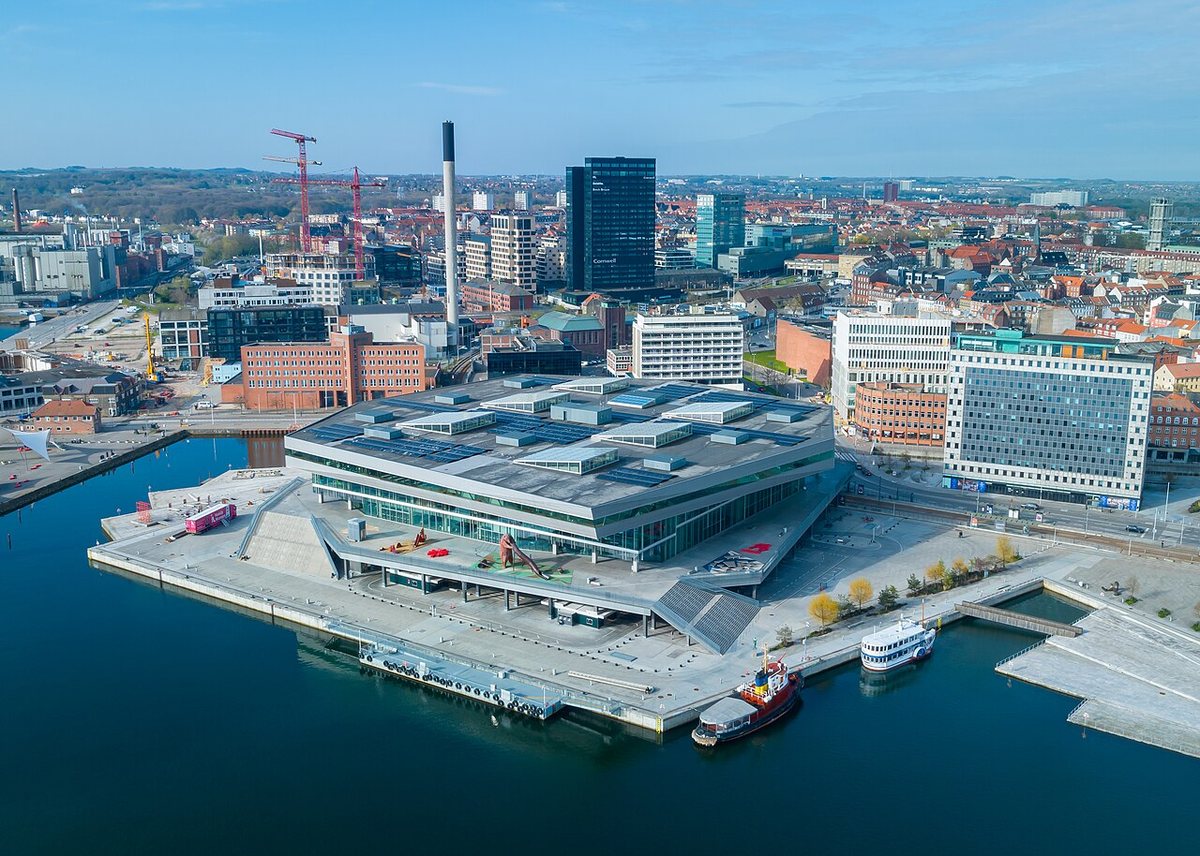
The largest public library in Scandinavia and a masterpiece of Scandinavian design — DOKK1 sits at the waterfront where the city meets the sea. More than a library: an entire cultural campus with free indoor and outdoor playgrounds, dressing-up areas, maker spaces, and the “Endless Connection” fountain at Havnepladsen (the plaza in front) where two-metre-high water walls shoot up from the ground — children sprint through them in summer and inevitably get soaked. Bring a change of clothes. The building is extraordinary to explore even for architecture-curious older children.
- Rating: 4.5/5 on Google
- Age suitability: All ages; playground best for 2–10
- Cost: FREE
- Time needed: 1–3 hours
- Location: Hack Kampmanns Plads 2 — right on the waterfront
- Open: Mon–Fri 8am–10pm; Sat 10am–8pm; Sun 10am–6pm
- Pro tip: The harbour fountain is best in warm weather. The library’s children’s floor is brilliantly designed — even if kids can’t read Danish, the books-and-play zones are welcoming.
- Website: dokk1.dk
9. Botanical Garden & Tropical Greenhouses
Aarhus University’s botanical garden includes four climate zones in a series of Victorian-style glasshouses: a tropical forest zone, a Mediterranean zone, a desert zone, and a cool temperate zone. Butterflies flit through humid warmth while pre-recorded wildlife sounds play overhead — children are enchanted. The outdoor garden is beautiful and has a large children’s playground with a zip line, water play features, and a carousel. Best of all, entry to both the garden and the greenhouses is free.
- Rating: 4.4/5 on Google
- Age suitability: All ages; greenhouses wonderful for 3+ (humidity and butterflies captivate small children)
- Cost: FREE
- Time needed: 1–2.5 hours
- Location: Møllevejen 10 — adjacent to Den Gamle By (easy to combine)
- Open: Garden: year-round. Greenhouses: typically Tue–Sun 10am–4pm — check botaarhus.dk
- Pro tip: Combine with Den Gamle By for a full-day outing. The playground zip line is a genuine hit for 5–12s.
- Website: botaarhus.dk
10. Marselisborg Palace Gardens & Royal Deer Park (Free)
The summer and Christmas residence of the Danish royal family sits in a park south of the city. When the royals aren’t in residence, the beautiful English-style palace gardens and rose gardens are open free to the public. When the royals are in residence (typically July and around Christmas), the gardens close — but the changing of the Royal Life Guard ceremony happens at noon daily, viewable from the road. A lovely piece of living Danish royal tradition. Adjacent to the palace is the Marselisborg Deer Park — free, fenced, and you walk among freely roaming deer, fallow deer, and wild boar. Children are eye-to-eye with animals who barely acknowledge them.
- Rating: 4.5/5 on Google (park); 4.3/5 (deer park)
- Age suitability: All ages; deer park wonderful for all
- Cost: FREE (both park and deer park)
- Time needed: 1–2 hours
- Location: Kongevejen 100 — 3km south of city centre (Bus 15 or 19)
- ⚠️ Honest note: The palace garden closes when royals are in residence — check the royal calendar before going specifically for the garden. The deer park is always accessible.
- Pro tip: Early morning in the deer park when animals are active and the light is golden. The walk through Marselisborg Forest to reach the area is itself lovely.
11. Moesgaard Beach & Ancient Trail
One of the most unusual beach walks in Denmark: hike 4km through Marselisborg Forest from Moesgaard Museum along the Ancient Trail — a path that passes reconstructed prehistoric monuments, burial mounds, and Viking-era structures — and arrive at a sandy blue-flag beach. The beach has a natural, unspoiled feel, a summer café/kiosk, and lifeguard in peak season. Children who do the museum and the trail and then swim have had a genuinely extraordinary day.
- Rating: 4.4/5 on Google
- Age suitability: Trail best for 5+; beach for all
- Cost: FREE (trail and beach); museum entry separate
- Time needed: Full day (museum + trail + beach)
- Location: 8km south of Aarhus; take Bus 18 to the museum
- Pro tip: Walk the trail one-way (museum to beach) and return by bus or taxi. Bring picnic; the beach café is popular and can be crowded. June–September for swimming.
12. Bellevue Beach
Aarhus’s most family-friendly beach for young children — specifically praised for the exceptionally gentle slope into the water (very shallow for a long way out), giving parents peace of mind with toddlers. Located 4km north of the city centre in Risskov, easily accessible by bus. Sandy, clean, with a kiosk and changing facilities. On warm summer days, Aarhus families converge here for the afternoon.
- Rating: 4.4/5 on Google
- Age suitability: All ages; particularly ideal for 0–8 with the shallow water
- Cost: FREE (public beach)
- Location: Strandvejen, Risskov (Bus 11 from the city)
- Pro tip: Arrive early on hot days — the bus stop is right by the beach. Pair with an ice cream at the kiosk.
13. Møllestien & The Latin Quarter
Møllestien is consistently voted the most beautiful street in Aarhus — a narrow cobblestone lane lined with tiny coloured houses from the 1870s and 1880s, each with flower boxes and leaning gently into each other like old friends. It’s extremely small (barely 100 metres) but utterly photogenic and a perfect illustration of old Danish domestic life. Combine with a wander through the Latin Quarter — Aarhus’s bohemian historic quarter with independent cafés, boutiques, and the canal-side street Åboulevarden where people drink coffee at outdoor tables along the water on warm evenings.
- Rating: 4.7/5 on Google (Møllestien)
- Age suitability: All ages; best for older children who can appreciate atmosphere
- Cost: FREE
- Time needed: 1–2 hours strolling
- Location: Latin Quarter, central Aarhus — Møllestien is near the cathedral
- Pro tip: Visit Møllestien in the morning before the tourists arrive — it’s a genuinely lovely moment. Ice cream on Åboulevarden watching canal life is a perfect Aarhus afternoon.
14. Salling Rooftop (Free City View)
Aarhus’s answer to a free city panorama: take the elevator to the rooftop of the historic Salling department store in the city centre and find a beautifully designed free public rooftop garden with seating, a greenhouse bar, and a glass walkway that juts out above the pedestrian street below. Kids can look straight down at the shoppers. The views over Aarhus are lovely, particularly at golden hour.
- Rating: 4.4/5 on TripAdvisor — “Architecture Award 2018”
- Age suitability: All ages; the glass overhang is a hit with older children
- Cost: FREE (lift access within the store; drinks optional)
- Location: Søndergade 27, city centre — inside Salling department store
- Open: Follows Salling store opening hours
- Pro tip: Great for an afternoon coffee break. The glass walkway above the street is a quick thrill for kids. Pair with a walk down the Strøget pedestrian shopping street below.
🎭 Special Experiences
15. Aarhus Street Food Market
A permanent covered street food market near the waterfront with 30+ stalls from cuisines around the world — Danish smørrebrød, Indian curry, American BBQ, Thai noodles, and more. Communal seating, rotating street food trucks, multiple bars. Casual, lively, and genuinely great for families who want to let everyone choose their own meal from different cuisines.
- Rating: 4.2/5 on TripAdvisor
- Age suitability: All ages
- Cost: Meals from ~DKK 80–150 (€11–20) per person
- Location: Ny Banegårdsgade — near the train station
- Open: Daily from 11am, late nights on weekends
- Pro tip: Arrive slightly before peak lunch to get seats together. Great option for groups with picky eaters.
🍕 Family-Friendly Food
16. Danish Classics & Local Food Culture
Aarhus is one of the best dining cities in Scandinavia — it has more Michelin-starred restaurants per capita than most European cities its size. For families, the sweet spot is the canal-side café culture on Åboulevarden and the Latin Quarter’s independent restaurants.
Smørrebrød (Open-faced sandwiches): The authentic Danish lunch experience — dark rye bread piled with herring, smoked salmon, roast beef, pickled vegetables, or creamy egg. Many locals canteens serve traditional smørrebrød from 11am–2pm at reasonable prices (DKK 60–100 per piece). Kids who try it often love the simpler varieties.
Æbleskiver (Danish donuts): Ball-shaped pancakes eaten with powdered sugar and jam, found at Christmas markets and seasonal bakeries. Children are universally delighted.
Danish pastries (Wienerbrød): Genuine Danish pastries from a local bakery (lagkage, snegle, hindbærsnitter) bear almost no resemblance to the airport version. Find a good konditori and treat the family.
17. Lagkagehuset (Multiple Locations)
Denmark’s most beloved bakery chain — extraordinary quality breads, pastries, sandwiches, and cakes at very reasonable prices. The quintessential Danish breakfast or lunch stop. Multiple locations in the city centre. Their hindbærsnitter (raspberry slice) is a non-negotiable.
- Rating: 4.5/5 on Google
- Cost: Pastries from DKK 25–45; filled sandwiches ~DKK 60–80
- Website: lagkagehuset.dk
18. Baest / Canal-Side Cafés, Åboulevarden
The canal boulevard Åboulevarden in the Latin Quarter is Aarhus’s social heart — lined with outdoor café tables from spring to autumn where locals sit for hours with coffee and ice cream. Most cafés here serve simple but good food: open sandwiches, burgers, pizza, and great cakes. Family-friendly and genuinely pleasant as a people-watching lunch spot.
- Cost: Café meals ~DKK 120–200 per person
- Pro tip: On a warm day, grab a coffee or ice cream and sit at the water’s edge. The canal has small bridges and ducks — children’s entertainment is built in.
🌊 Day Trips
Day Trip 1: Legoland Billund & LEGO House ⭐⭐ (The #1 Family Day Trip)
Distance: ~1 hour drive from Aarhus | Also reachable by bus ~1.5h
THE essential Danish family experience. LEGO was invented in Billund in 1932 and the original Legoland has been here since 1968. The park spans over 100,000 m² with 50+ rides, spectacular LEGO Miniland (famous cities built from 20 million LEGO bricks), water rides, themed areas from pirates to Ninjago, and a dedicated DUPLO area for the youngest visitors. It is a seriously well-run park with excellent accessibility and family facilities.
LEGO House (5-minute walk from Legoland) is a separate, newer experience — 4 colour-coded “zones” where children build, explore, and play with LEGO in architecturally stunning settings. It’s smaller and more intimate than the park; many families do both on the same ticket.
- Rating: 4.6/5 on TripAdvisor — perennial Travellers’ Choice
- Age suitability: Legoland: best for 3–12; LEGO House: 4–adult (surprisingly compelling for grown-ups too); Under-2 free
- Cost: Online day tickets from ~DKK 380/person (save DKK 70–170 vs walk-in); under-2 FREE. Combined Legoland + LEGO House ticket available. Season passes (DKK 799 per person) pay off in 3 visits.
- Time needed: Full day (each venue deserves 4–6 hours alone)
- Open: Legoland: April to October (plus Christmas season). LEGO House: year-round.
- ⚠️ Honest note: School holiday weeks and weekends get genuinely busy — popular rides have 45-minute queues. Go mid-week in June or September for the best experience. The park is expensive for food — pack snacks. Legoland is not Disneyland in scale, but it’s a far superior experience for LEGO-loving children aged 4–12.
- Pro tip: Book online well in advance (prices rise closer to date). Download the Legoland app for real-time queue updates. Arrive at opening. Do the most popular rides first, then DUPLO World during midday when families with toddlers are napping. In summer there is a free Billund City Shuttle between Legoland and LEGO House and Billund Airport.
- Website: legoland.dk | legohouse.com
Day Trip 2: Randers Regnskov — Tropical Rainforest Zoo
Distance: ~40 minutes drive from Aarhus | Also reachable by train+bus
One of the most unusual zoo experiences in Scandinavia: a climate-controlled indoor tropical rainforest spread across 4,450 m² of indoor space and 22,000 m² of outdoor habitat — all under a enormous glass dome. Three dome sections recreate different rainforest environments: Africa (gorillas, crocodiles), the Americas (boa constrictors, piranhas, sloths), and Asia (orangutans, giant pythons, Komodo dragons). You walk through the actual habitats on raised walkways, surrounded by genuine tropical heat and humidity and the sounds of the jungle. It’s completely unlike any conventional zoo. Children who can’t stand “animals behind glass” are transformed here — the boa constrictor may be 2 metres from your face.
- Rating: 4.5/5 on TripAdvisor — consistently excellent for families
- Age suitability: All ages; particularly 3–14
- Cost: Adult 235 DKK (€31) | Child 3–11: 150 DKK (€20) | Under-3: FREE
- Time needed: 3–5 hours
- Location: Tørvebryggen 11, Randers (40 min north of Aarhus by car; ~1h by train+bus)
- Open: Daily; check regnskoven.dk — closed late November for maintenance
- ⚠️ Honest note: The tropical heat inside the domes is very real — dress appropriately (the humidity is genuine). Some animals are nocturnal and may be less visible at certain times. The outdoor section is only enjoyable in good weather.
- Pro tip: Visit on a grey or rainy day — stepping into a tropical rainforest when it’s cold outside is a spectacular contrast. The gorilla dome is the highlight — time your visit around their feeding times.
- Website: regnskoven.dk
Day Trip 3: Ebeltoft — The Fairytale Medieval Town
Distance: ~45 minutes drive from Aarhus | ~1.5h by bus
If you want to see the Denmark of travel posters — cobblestone streets, leaning half-timbered houses from the 1600s in Easter-egg colours, hollyhocks spilling over fences, a perfectly preserved medieval town hall — Ebeltoft is where to go. Unlike Den Gamle By (where buildings were moved to Aarhus), these are the actual original buildings in their original locations. The town’s Glasmuseet Ebeltoft is one of the finest glass art museums in the world, and its approach to making glass art accessible to children is excellent. The harbour has an extraordinary sight: the Fregatten Jylland, Denmark’s oldest surviving warship from 1860, preserved in dry dock and open to board.
- Rating: 4.5/5 on Google (town); 4.3/5 TripAdvisor (Glasmuseet)
- Age suitability: Town: all ages; Glasmuseet: 8+; Fregatten: 5+
- Cost: Town is free to wander. Glasmuseet: Adult ~120 DKK / Under-18 FREE. Fregatten Jylland: Adult ~95 DKK / Child ~50 DKK
- Time needed: 3–5 hours
- Location: 45 min drive east of Aarhus on the Djursland peninsula
- Pro tip: Summer hollyhocks (July) make Ebeltoft’s streets absolutely extraordinary — plan a visit in peak flower season. The harbour has good fish-and-chips for lunch. Combine with a drive along the Djursland coast for scenery.
- Website: glasmuseet.dk | fregatten-jylland.dk
💡 Practical Tips for Families
Best Areas to Stay with Kids
| Area | Why | Best for |
|---|---|---|
| City Centre / Latin Quarter | Walking distance to ARoS, Den Gamle By, Salling, DOKK1, restaurants | Families who want walkable convenience |
| Aarhus Ø (Harbour) | Modern, scenic, waterfront walks, close to DOKK1 | Families with older children |
| Risskov (north) | Quiet, near Bellevue Beach | Beach-focused families |
💡 Recommendation: City centre or Latin Quarter with a rental car for day trips. Virtually all Aarhus attractions are walkable or a short bus ride from the central area.
Danish Customs Families Should Know
- Danes love children — you will be genuinely welcomed in restaurants and public spaces. Highchairs and children’s menus are standard.
- Under-18 museum entry is FREE across all major Aarhus museums — this is a consistent city-wide policy and represents extraordinary value for travelling families.
- Hygge (hoo-ga): The Danish concept of cosiness, togetherness, and simple pleasures — candles, warm drinks, good company — is real and tangible in Aarhus, especially in cafés and at Tivoli Friheden.
- Cycling culture: Bikes have right-of-way in dedicated lanes. Be aware with young children near cycle paths — look both ways before stepping onto them.
- Danes are very direct — helpful, friendly, and English-fluent, but they won’t small-talk. Don’t mistake directness for unfriendliness.
- Tipping: Not expected in Denmark but appreciated — rounding up is common; 10% is generous.
Safety Notes
- 🟢 Denmark is extremely safe — one of the safest countries in the world. Aarhus is a genuinely low-crime city.
- 🌧️ Weather: Danish weather is famously changeable — even in summer, rain can arrive without warning. Pack a light waterproof layer for all ages.
- 💶 Cards everywhere: Denmark is essentially a cashless society. Cards (Visa/Mastercard) are accepted at food stalls, museums, taxis — anywhere. Cash is almost never needed.
- 🌞 Sun awareness: Danes typically don’t experience strong UV — but summer sun at this northern latitude is surprisingly intense when it appears. Apply SPF on clear days.
- 🚲 Bike safety: Take care with young children near cycle lanes — they move fast and silently.
💰 Money-Saving Tips
The Under-18 Museum Rule
Every major museum in Aarhus — ARoS (€27 adult), Moesgaard (DKK 180), Den Gamle By (DKK 190), Steno Museum, Natural History Museum — admits anyone under 18 completely free. A family of two adults and three children pays only 2 adult admissions. This is genuinely transformative for family travel budgets.
Midttrafik Day Ticket
Adults bringing two children under 12 ride free on a single adult day ticket. Family public transport at exceptional value.
Free Attractions Worth Planning Around
- DOKK1 waterfront cultural centre (free all day)
- Botanical Garden & Tropical Greenhouses (free)
- Marselisborg Palace Garden (free when royals away)
- Marselisborg Deer Park (always free)
- Salling Rooftop panorama (free)
- Bellevue Beach (public beach)
- Moesgaard Ancient Trail (free)
- Møllestien and Latin Quarter walking (free)
Book Online
Legoland: DKK 70–170 cheaper online. ARoS: small online discount. Randers Regnskov: check website for combo deals.
Supermarkets
Netto, Rema 1000, and Lidl stores are affordable for self-catering families. Danish supermarkets have excellent quality bakery sections for cheap pastry breakfasts.
📋 Quick Reference: Activities at a Glance
| Activity | Age Best | Cost (family of 4) | Duration | Season |
|---|---|---|---|---|
| ARoS Art Museum + Rainbow Panorama | 6–18 | ~€54 (2 adults; under-18 FREE) | 2–4 hrs | Year-round |
| Moesgaard Museum | 7+ | ~€48 (2 adults free) | 2–4 hrs | Year-round |
| Den Gamle By | 4–14 | ~€50 (2 adults free) | 3–6 hrs | Year-round |
| Tivoli Friheden | All | ~DKK 600+ (entry+rides) | 3–6 hrs | Apr–Oct, Dec |
| DOKK1 Waterfront & Playground | All | FREE | 1–3 hrs | Year-round |
| Botanical Garden & Greenhouses | All | FREE | 1–2 hrs | Year-round |
| Marselisborg Palace Garden | All | FREE | 1 hr | When royals away |
| Marselisborg Deer Park | All | FREE | 30–60 min | Year-round |
| Moesgaard Beach + Ancient Trail | 5+ | FREE | Half–Full day | May–Sep |
| Bellevue Beach | All | FREE | 2–4 hrs | Jun–Sep |
| Salling Rooftop | All | FREE | 30–60 min | Year-round |
| Steno Museum + Planetarium | 6–15 | ~DKK 120 (under-18 FREE) | 1.5–3 hrs | Year-round |
| Aarhus Street Food Market | All | ~DKK 600 for family | 1–2 hrs | Year-round |
| Legoland Billund | 3–12 | ~DKK 1,500–2,000 (online) | Full day | Apr–Oct |
| Randers Regnskov | 3–14 | ~DKK 770 (2 adults + 2 kids) | 3–5 hrs | Year-round |
| Ebeltoft Day Trip | All | ~DKK 200 (free to walk town) | 3–5 hrs | Year-round |
✈️ Getting to Aarhus
Closest airports:
- Aarhus Airport (AAR): 40km north of the city. Small but direct flights from select European cities. Bus to city ~45 min, DKK 120.
- Billund Airport (BLL): Best option — 100km/1h south-west of Aarhus. Many European direct flights. Buses to Aarhus Central Station run frequently (~180 DKK per adult, 1.5h).
- Copenhagen Airport (CPH): Largest hub — 300km away. Train to Aarhus ~2.5–3 hours. Book via dsb.dk — from ~100 DKK per adult book in advance.
By Train from Copenhagen:
Copenhagen H (Central Station) or Copenhagen Airport (Lufthavn) → Aarhus H (Central Station). Non-stop services available. Scenic route through the Danish countryside. Book early for the cheapest fares.
Guide compiled March 2026. Prices listed in Danish Krone (DKK) and Euros (€) — DKK 100 ≈ €13. All prices subject to change; verify on official websites before visiting. Museum free-under-18 policies confirmed at time of research but always double-check at visitaarhus.com.