🇪🇸 Alicante — Family Travel Guide
Country: Spain Last Updated: May 2026
Overview
Alicante sits on Spain’s Costa Blanca with an unusual combination of assets that families genuinely appreciate: a medieval castle visible from almost everywhere in the city, a clean city beach 10 minutes’ walk from a handsome old town, and a holiday resort coast (Benidorm) 40 minutes north that’s packed with world-class water parks and theme parks. The city itself is compact and walkable, the climate is one of the sunniest in Europe (330 days of sun a year is the local boast), and flights are cheap from most UK and European cities.
What Alicante offers that you won’t find elsewhere is a combination of a genuinely historic Spanish city — with a proper weekly market, a castle that’s free to visit, a tree-lined promenade famous across Spain for its mosaic pavement — and a day-trip corridor of entertainment that puts Beach, theme park, water park, and zoo all within an hour. It’s also a gateway to the UNESCO Palmeral of Elche (Europe’s largest palm grove), and the extraordinary mountain village of Guadalest, which are among the best day trips on the Mediterranean coast.
The city is often overlooked in favour of Barcelona or Valencia, which means you get the Spanish holiday experience without the queues or price premium. Accommodation, food, and activities are notably cheaper than the Catalan coast. The flip side: Alicante lacks a world-class headline attraction like Gaudí’s work, and as a beach-resort city, some of the tourist infrastructure (particularly around the port and Postiguet beach in peak summer) can feel slightly worn. That said, for families wanting warmth, history, beaches, and easy day-trip entertainment, Alicante punches well above its tier.
Why families love it:
- Castillo de Santa Bárbara — a free, dramatic hilltop fortress kids instantly want to explore
- City beach (Postiguet) steps from the old town; wider, calmer Playa de San Juan 7km north
- Benidorm day-trip corridor: Terra Mítica, Aqualandia, Terra Natura, and Mundomar all within 40 minutes
- Isla de Tabarca — Spain’s smallest inhabited island by ferry, with medieval walls, crystal water, and a pirate story children love
- MARQ archaeology museum consistently rated one of Spain’s best for interactive family visits
- Spanish family dining culture: no raised eyebrows at children out late, generous portions, affordable menus del día
- Budget flights from the UK and northern Europe year-round; significantly cheaper than Barcelona or the Balearics
⏰ Best Time to Visit with Kids
| Season | Conditions | Verdict |
|---|---|---|
| Apr–Jun | 20–28°C, warm but not intense, beaches opening, all attractions open | ⭐ Best for families |
| Jul–Aug | 30–36°C, beaches packed, ferry queues, peak prices | 🔴 Very hot — manageable with early starts and midday shade |
| Sep–Oct | 24–30°C, sea still warm, crowds dropping sharply | ⭐ Excellent |
| Nov–Mar | 12–18°C, sunshine likely, sea cold, some day trips close | ✅ Good for city sightseeing; no beach swimming |
Pro tip: Late September and October are arguably the best weeks of the year — the sea is at its warmest (often 24°C), the tourist crowds have departed, and the city feels genuinely Spanish again. Easter and the local Hogueras de San Juan festival in late June (enormous bonfires and street celebrations) are both wonderful times to visit with children. July and August are not recommended unless you’re very comfortable with heat and can get to beaches early — Alicante regularly hits 37°C inland in August.
🚗 Getting Around
On Foot Alicante’s centre is compact and flat. The main attractions — Postiguet beach, the castle lift entrance, the Explanada de España, the old town, MACA, and the Mercado Central — are all within a 15-minute walk of each other. This is an excellent city for walking families.
Local Bus (TAM) Alicante’s municipal bus network covers the city and beach suburbs. Line C-6 runs from the city centre to Playa de San Juan (30 min, ~€1.45 each way). Line 21 covers the MARQ museum area. Buy single tickets on the bus or a 10-trip Bonobus card from newsagents for better value.
TRAM (Alicante–Benidorm Line 1) The TRAM service connects Alicante city centre to San Juan beach (10 min), Campello, Villajoyosa, and Benidorm (roughly 70 min) — a scenic coastal railway that’s a highlight in itself. Runs from the TRAM station at Luceros square. Single to Benidorm ~€4.80 adult / €2.40 child. This is a genuinely enjoyable way to reach the Benidorm coast.
Car Rental (Recommended for Day Trips) For Elche, Guadalest, Terra Mítica, and Jijona, a hire car makes sense. Alicante airport has all major rental companies. Roads are well signposted and parking in day-trip destinations is generally easy. Driving in Alicante city itself is unnecessary — parking is frustrating and the centre is best on foot.
Taxi / Cabify Reliable and metered within the city. Useful late at night or with young children and luggage. Cabify app works well throughout the province.
Tabarca Ferry Ferries to Isla de Tabarca depart from Alicante port (Muelle de Poniente) and take 45 minutes. FRS Iberia operates the main service; buy tickets at the port or online. More details in the Tabarca section below.
🏰 Castillo de Santa Bárbara & the Old Town
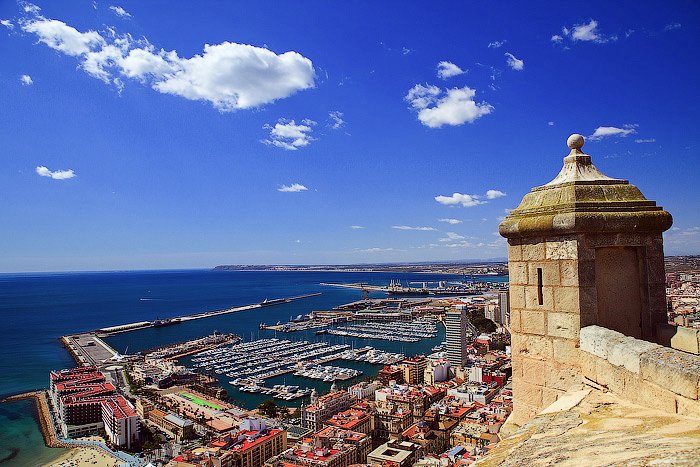
Alicante’s defining landmark — a 16th-century Moorish-Spanish fortress perched on the Benacantil rock 166 metres above the city — is visible from virtually everywhere and immediately captures children’s imagination. The castle’s scale, the cannon ramparts, the sheer walls of volcanic rock, and the sweep of coastline from the battlements make it one of the most dramatic free attractions in southern Spain. Unlike many Spanish castles that are half-ruined or inaccessible, Santa Bárbara is large, well-maintained, and genuinely explorable.
1. Castillo de Santa Bárbara ⭐
The fortress has three levels connected by paths and stairs: the lower citadel (Plaza de Armas) with the main entrance buildings, the middle section (Cuerpo de Guardia) with the best coastal views, and the upper keep — the oldest part, with foundations from the 9th century under the Moors. The panoramic views from the top extend along the Costa Blanca in both directions, and on clear days you can see the mountains of Elche to the south. There are information panels throughout explaining the history — Spanish and English versions available.
The free elevator is the defining highlight for families: a tunnel cuts through the rock from Postiguet beach side, ascending 160m to emerge at the castle’s upper section. Children find this extraordinary — the lift literally rises through a mountain. There’s also a walkable path up from the old town (Barrio de Santa Cruz) which takes about 20 minutes and passes some of the city’s prettiest whitewashed lanes.
- Rating: 4.4/5 on TripAdvisor (12,000+ reviews)
- Age suitability: All ages; best for 4+; the lift is accessible with pushchairs
- Cost: FREE (both the castle entry and the elevator). A small tourist train also runs from the city centre in summer (~€3).
- Time needed: 1.5–2.5 hours
- Location: Monte Benacantil, Alicante. Elevator entrance: Avenida Juan Bautista Lafora, s/n (underground entrance from Postiguet beach road). Walk-up: from Calle Mayor through Barrio de Santa Cruz.
- Open: October–March 9am–6pm; April–September 9am–10pm (free elevator runs same hours, last entry 30 min before close)
- ⚠️ Honest note: The elevator can have queues on summer mornings — arrive at 9am to avoid them. The upper castle area is exposed with significant drops that aren’t always fenced — keep a close eye on young children near the walls and ramparts. Comfortable shoes essential; some paths are steep stone.
- Pro tip: Walk up via the Barrio de Santa Cruz in the morning (the streets are beautiful and shaded early in the day) and take the lift down to Postiguet beach. This combines the castle visit, old town exploration, and a beach arrival naturally into one morning. Pair with a tostada breakfast at a café in the Barrio before heading up.
- Website: castillodesantabarbara.com
The Barrio de Santa Cruz & La Explanada de España
The old town immediately below the castle — the Barrio de Santa Cruz — is Alicante’s most photogenic neighbourhood: steep whitewashed lanes hung with flower pots, small plazas, painted staircases, and local cats on every corner. The contrast between the ancient barrio and the modern waterfront below is part of Alicante’s character. It’s completely free to wander and children respond well to the maze-like quality of the streets.
Down on the waterfront, La Explanada de España is the city’s iconic palm-lined promenade, paved with six million marble tiles in red, white, and black wavy patterns. This is where Alicante comes to evening-stroll (the paseo culture is strong here), and where you’ll find the city’s most pleasant café terraces. It connects the port to the old town in a 10-minute flat walk. UNESCO listed the tradition of the paseo here — the evening promenade is genuinely one of Alicante’s most distinctive and enjoyable experiences.
🏖️ Beaches
Alicante has two very different beach options within easy reach, each suited to different family priorities.
2. Postiguet Beach (City Beach)
Playa del Postiguet sits directly below the castle — 800 metres of sand wedged between the rocky castle hill and the city promenade. Its location is its superpower: you can spend the morning at the castle, descend the lift, and be on the beach in five minutes. The city centre is a five-minute walk. It’s Blue Flag certified, lifeguarded from June to September, with sun lounger hire, beach showers, and good café facilities. The backdrop — city buildings on one side, the castle looming on the other — is dramatic and distinctly Spanish.
The honest caveat: Postiguet gets very crowded in July and August, the sand can be hard to find on peak weekends, and the beach is relatively narrow. If you’re spending multiple days, treat Postiguet as the convenient option (perfect for a quick swim between sightseeing) rather than your main beach day.
- Rating: 4.1/5 on Google
- Age suitability: All ages; calm entry, suitable for young children
- Cost: Free; sun loungers ~€8–12/day; kayak hire available in summer
- Time needed: 1–3 hours
- Location: Avenida Juan Bautista Lafora (below the castle, 5 min walk from old town)
- ⚠️ Honest note: Crowded in peak summer. Pickpocketing on crowded beaches is a minor risk — don’t leave valuables unattended.
- Pro tip: Come at 8–9am in summer before the crowds arrive, swim, have breakfast at the beach café, and head into the city before 11am. Out of season (September–October), Postiguet is often quiet, warm, and wonderful.
3. Playa de San Juan (Best for Families)
Seven kilometres north of the city centre, Playa de San Juan is a completely different proposition: 7km of wide, open sand with significantly more room, calmer and slightly cooler water than the city beach, playgrounds directly on the sand, water sports concessions, beach bars, and a more relaxed atmosphere. It’s the preferred beach for local Alicantino families on summer weekends. Blue Flag certified. The urbanisation behind the beach (Playa de San Juan suburb) has good restaurants, supermarkets, and apartment rentals.
Getting there: TRAM Line 1 from central Alicante (10 min, very scenic coastal stretch); local bus C-6 (~30 min); car (10 min, with parking available for a fee in summer).
- Rating: 4.4/5 on Google (among the highest-rated beaches on the Costa Blanca)
- Age suitability: All ages; excellent for 0–12 with gentle entry and ample space to dig and play
- Cost: Free; sun loungers ~€8–12/day; water sports equipment hire from ~€15/hr
- Time needed: 3–6 hours (half or full day)
- Location: 7km north of city centre, served by TRAM Line 1 or bus C-6
- ⚠️ Honest note: The stretch directly adjacent to the Albufereta urban area at the southern end is more crowded. Head north along the sand for more space.
- Pro tip: Take the TRAM from Luceros — the 10-minute coastal ride is a highlight and you avoid any parking headache. Get off at Playa de San Juan TRAM stop. Combine the beach afternoon with the MARQ museum in the morning (which is located on the way, at the northern edge of the city).
🏛️ Museums & Culture
Alicante is surprisingly strong on museums for a city of its size, and the two main family-relevant options are very well done.
4. MARQ — Museo Arqueológico Provincial de Alicante ⭐
One of Spain’s most acclaimed regional archaeology museums — and one of the rare museums where children are the key design audience, not an afterthought. MARQ (Museo ARQueológico Provincial de Alicante) won the European Museum of the Year Award in 2004, and its combination of genuine artefacts, theatrical staging, and interactive exhibits holds up exceptionally well. The permanent collection covers the entire sweep of human life on this coast from prehistoric times through Iberian, Roman, Islamic, and Medieval periods. Exhibits include actual human remains, Iberian warrior tombs, Roman statues, and a reconstructed Moorish house — but the presentation makes it accessible and genuinely engaging for children from about age 6 upwards.
The museum stages temporary exhibitions, kids’ workshops, and school holiday activities year-round. The building itself — a beautifully converted neoclassical hospital with a modern extension — is impressive.
- Rating: 4.5/5 on Google / 4.4 TripAdvisor (consistently top-rated museum in Alicante)
- Age suitability: Best for 6–16; some interactive elements suit younger children
- Cost: Adults €3 / Children (under 12) FREE / Reduced €1.50. Family ticket (2 adults + 2 children) available. One of the best-value museum entries in Spain.
- Time needed: 1.5–3 hours
- Location: Plaza del Doctor Gómez Ulla, s/n (near the TRAM stop Luceros/La Marina, northern edge of city centre)
- Open: Tue–Sat 10am–7pm (summer until 8pm); Sun 10am–2pm; closed Monday
- ⚠️ Honest note: The museum signage is primarily in Spanish. Free audio guides are available in English — pick these up at reception or ask at the desk. Some of the more graphic exhibits (human remains, war artefacts) may need brief parental guidance for sensitive younger children.
- Pro tip: Combine MARQ with Playa de San Juan on the same day — the museum is at the northern edge of town and San Juan beach is 3km further north via the TRAM. Morning museum, afternoon beach. Get the English audio guide — it transforms the experience significantly.
- Website: marqalicante.com
5. MACA — Museo de Arte Contemporáneo de Alicante (Free)
Alicante’s contemporary art museum occupies the oldest civic building in the city — the beautiful 17th-century Casa de la Asegurada in the old town, just below the castle. Admission is FREE. The permanent collection spans from the early 20th century to the present, with works by Picasso, Miró, Chillida, Dalí, and other major Spanish artists. For families, the real value is the setting — the building itself is fascinating — and the Picasso and Miró works, which children often respond to with genuine engagement, particularly the more playful and abstract pieces.
- Rating: 4.1/5 on Google
- Age suitability: Best for 8+; free makes it easy to include as a short visit
- Cost: FREE
- Time needed: 45 min–1.5 hours
- Location: Plaza de Santa María, 3 (Old Town, base of the castle)
- Open: Tue–Sat 10am–8pm; Sun 10am–2pm; closed Monday
- ⚠️ Honest note: It’s a small museum — don’t allocate a full afternoon. Treat as a 45-minute add-on when passing through the old town.
- Pro tip: Combine with the Santa Cruz barrio walk and the castle visit — the three are literally adjacent to each other. The plaza outside MACA is lovely for a coffee while the children explore.
- Website: maca-alicante.es
6. El Parque Municipal & the Peacocks
Alicante’s central municipal park — a formal Victorian-style garden with palm trees, flower beds, fountains, children’s play areas, and the city’s most famous secret: a resident flock of peacocks that wander freely among visitors. Children are reliably delighted by the peacocks, particularly during breeding season (spring–early summer) when the males display their full tail feathers. The park also has an outdoor playground and is adjacent to the city’s main markets and shopping streets. Completely free to enter.
- Rating: 4.3/5 on Google
- Age suitability: All ages; excellent for toddlers and young children
- Cost: FREE
- Time needed: 30–90 minutes
- Location: Avenida de Alfonso el Sabio (behind the bus station, central Alicante)
- Pro tip: Visit in spring when peacocks display. The park café is a good, inexpensive stop for a mid-morning coffee and a snack. The children’s play area is well-maintained and shaded.
🎢 Benidorm Day Trips
The 40km stretch of coast north of Alicante — largely based around Benidorm — contains one of Europe’s highest concentrations of family entertainment outside of Orlando. Within a 45-minute drive (or a scenic TRAM ride) you have a major theme park, one of Spain’s best water parks, a well-run zoo, and a marine animal park. These attractions are the reason many families choose Alicante as their Costa Blanca base over Benidorm itself — you get the entertainment access without having to stay in Benidorm’s high-rise resort zone.
7. Terra Mítica Theme Park ⭐
Terra Mítica is the main theme park on the Costa Blanca — a sprawling park themed around five ancient Mediterranean civilisations (Egypt, Greece, Rome, Iberia, and the Islands) with an impressive line-up of rides across all age groups. The big coasters (El Péndulo, Inferno, Magnus Colossus — one of Spain’s longest wooden roller coasters) are genuine thrill rides; the Egypt and Islands zones have gentler family rides for younger children; and the park includes water rides, live shows, and a dedicated children’s area.
The theming is earnest and slightly kitsch but children largely don’t care — the rides are well-maintained, the park is sizable without being overwhelming, and the combination of history and spectacle makes it more interesting than a generic amusement park. Expect a full day.
- Rating: 4.0/5 on TripAdvisor
- Age suitability: All ages; dedicated rides for under 1.2m; most thrill rides from 1.2–1.4m
- Cost: Adults ~€44 online / Children (under 1.2m) ~€35 / Under-3 FREE. Family packs available. Prices are significantly cheaper online than at the gate — always pre-purchase.
- Time needed: Full day (6–9 hours)
- Location: Partida Moralet, s/n, Benidorm (45 min from Alicante by car/TRAM + taxi)
- Open: Seasonal — typically late March to early November; July/August daily; spring/autumn weekends and some weekdays. Check website — the calendar changes annually.
- ⚠️ Honest note: Terra Mítica is Spain’s third-busiest theme park, so July/August queues can be 40–60 minutes for the headline rides. Buy the FastPass equivalent if visiting in peak summer. The park is exposed and hot in summer — hat and water essential, and shade is limited.
- Pro tip: Buy tickets online at least a few days in advance (20–30% cheaper). Visit on a Tuesday or Wednesday in summer for shorter queues. The park’s waterfall ride (El Río de las Pirámides) is spectacular in the heat — do it early before queues build. Pack lunch — park food is expensive.
- Website: terramitica.com
8. Aqualandia Water Park ⭐
Widely regarded as one of the best water parks in Spain, Aqualandia has an outstanding range of slides and attractions across all age groups — from the terrifying OzO (one of Spain’s tallest free-fall slides) to the enormous Kamikaze, an elaborate lazy river system, a dedicated children’s splash zone (Acqua Splash area), and multiple wave and activity pools. The park is well-maintained and large enough to feel spacious even in peak season. The Benidorm hillside location means some striking views between runs.
- Rating: 4.1/5 on TripAdvisor
- Age suitability: All ages; Acqua Splash children’s area excellent for under-8; full park from 6+
- Cost: Adults ~€35 online / Children (under 1.2m) ~€25 online / Under-3 FREE. Family packs available. Again, significantly cheaper online.
- Time needed: Full day
- Location: Avenida del Albir, Benidorm (40 min from Alicante by car)
- Open: Typically April–October (daily July–August; weekends and select days in shoulder months)
- ⚠️ Honest note: Lockers are mandatory for most big rides (not included in admission — ~€5–8/day). Apply high-factor sunscreen obsessively — you’re in water all day and it’s easy to burn severely. The park can feel crowded in August; the Acqua Splash children’s zone is particularly busy.
- Pro tip: Arrive when the park opens. The big thrill slides have shortest queues in the first 90 minutes. Pack high-factor water-resistant sunscreen and reapply every 2 hours. The park’s restaurants are mid-range and acceptable — bring snacks and filled water bottles for children to hydrate constantly.
- Website: aqualandia.net
9. Terra Natura Benidorm Zoo
Terra Natura is a wildlife park built on the principle of barrier-free animal viewing where possible — natural-looking habitats, minimal caging, and areas where visitors can walk alongside certain animals. The park covers Asia, America, Europe, and Africa zones. Highlights include the white tigers (striking and popular with children), primates, big cats, and a dedicated petting zoo and contact area with smaller animals that young children love. The park runs a daily programme of feeding demonstrations and zookeeper talks that are worth timing your visit around.
- Rating: 4.1/5 on TripAdvisor
- Age suitability: All ages; best for 2–12
- Cost: Adults ~€25 online / Children (3–12) ~€18 / Under-3 FREE. Combination tickets available with Mundomar (next entry).
- Time needed: 3–5 hours
- Location: Avenida de la Comunidad Valenciana, Benidorm (40 min from Alicante by car)
- Open: Daily year-round (reduced hours November–March)
- ⚠️ Honest note: Some of the primate habitats and big cat viewing areas are still conventional caged zones despite the park’s immersive marketing. Manage expectations: this is a good regional zoo, not a world-class wildlife park. That said, the contact area and feeding sessions are genuinely excellent for young children.
- Pro tip: Combination tickets with Mundomar save roughly €8–12 per person. Download the daily programme from the website and time your arrival to catch the sea lion show and white tiger feeding — these are the highlights.
- Website: terranatura.com
10. Mundomar Marine Park
Adjacent to Terra Natura, Mundomar specialises in marine animals and performing animal shows — dolphins, sea lions, parrots, exotic birds, and smaller animals in a waterpark setting. The shows are the main draw: the dolphin shows are well-staged and children are reliably engaged, the parrot show is genuinely funny for all ages, and there’s a good range of rides and splash zones to extend the visit. It’s the smallest of the four Benidorm-area parks and pairs naturally with Terra Natura as a combined day.
- Rating: 4.0/5 on TripAdvisor
- Age suitability: Best for 2–12
- Cost: Adults ~€24 online / Children (3–12) ~€18 / Under-3 FREE. Combined Terra Natura + Mundomar tickets available.
- Time needed: 2–4 hours (or combined full day with Terra Natura)
- Location: Avenida de la Comunidad Valenciana (adjacent to Terra Natura), Benidorm
- Open: Seasonal — typically April–October. Check calendar.
- ⚠️ Honest note: The animal shows involve trained animals performing tricks, which not all families will be comfortable with. Make a call based on your family’s values before booking.
- Pro tip: The combined Terra Natura + Mundomar ticket is excellent value and the two parks are literally adjacent — a natural full-day pairing. Download the show schedule and plan your day around the dolphin and sea lion show times.
- Website: mundomar.es
⛵ Isla de Tabarca Boat Trip
11. Isla de Tabarca ⭐
Isla de Tabarca is Spain’s smallest permanently inhabited island — a flat oval of rock roughly 1,800m long and 400m wide, located 22km southeast of Alicante in the Mediterranean. It’s genuinely extraordinary on several levels: the medieval walled town (Spain’s only walled island village) with its 18th-century church, defensive towers, and cannon-lined walls; the crystal-clear marine reserve waters that surround it (exceptional for snorkelling — some of the clearest water in Spain); and the pirate history that children find irresistible.
The island’s story is the kind of thing children remember: in the 18th century, King Carlos III repopulated the abandoned island with prisoners and freed captives from North African pirates, building the fortifications you see today. There are cannon emplacements, watchtowers, and a small chapel dedicated to Saint Peter and Saint Paul. The island has no cars, no tourist infrastructure beyond a handful of restaurants and the medieval village, and a population of around 50 permanent residents.
The marine reserve around Tabarca is one of Spain’s best underwater habitats — posidonia seagrass meadows, sea bass, octopus, and on lucky days, sea turtles. Bring snorkelling equipment from Alicante (or hire cheaply at the island) — this is the activity children most consistently mention in post-trip family reviews.
- Rating: 4.5/5 on TripAdvisor — consistently one of the most-loved half-day trips from Alicante
- Age suitability: All ages; snorkelling best from 5+; the boat trip itself is enjoyed by all ages
- Cost: Ferry adult ~€20–24 return / Children (under 12) ~€12–15 return / Under-3 frequently free. Prices vary slightly by operator. Book online in advance in summer.
- Time needed: Full half-day (4–5 hours including ferry)
- Location: Ferries from Alicante Port (Muelle de Poniente). Journey time 45 minutes each way. FRS Iberia operates the main service.
- Open: Year-round (summer has many daily departures; winter reduced service — check current timetable)
- ⚠️ Honest note: In peak summer (July–August), Tabarca gets significantly crowded and the small island can feel overwhelmed. The restaurants have long waits and the beaches are packed. Visit in May–June, September, or October for the best experience. The sea can be choppy for small children on rougher days — check the weather before departure.
- Pro tip: Bring your own snorkelling equipment — masks and fins from Alicante sports shops cost €15–25 and make an enormous difference to what you see. The best snorkelling is off the rocky northwest shore (away from the main beach and jetty) — walk five minutes past the village walls to find less-crowded water. Pack a picnic or eat at one of the island restaurants early (12pm) before the queues form.
- Website: tabarcaferries.com (FRS Iberia)
🍕 Food Experiences
Alicante has a strong food identity that goes well beyond standard beach-resort fare. The city sits at the heart of a rice-growing region and the signature dish — arròs a banda — is one of the great rice dishes of Spain. The tapas culture is genuine and local, not performed for tourists, and the city’s Mercado Central is a beautifully restored 20th-century market hall worth visiting for the atmosphere alone.
12. Arròs a Banda & the Rice Culture
Alicante’s signature dish is arròs a banda — “rice on the side” — a two-stage meal where fish and seafood are cooked in a rich broth, served first (the “banda”), and then the same broth is used to cook rice in a flat pan over high heat, served separately with alioli. The dish has an intensely savory, oceanic depth that’s different from paella. Children who like rice and mild fish flavours typically love it; those who don’t may prefer paella or fideuà (the same concept but with thin pasta noodles instead of rice).
Best places for arrós a banda:
- Nou Manolín (Calle Villegas 3) — the classic address; upstairs restaurant for more formal dining, downstairs tapas bar for casual
- Piripi (Calle Óscar Esplá 30) — consistently cited for the best traditional rice dishes in the city
- La Dársena (Muelle de Levante, port) — harbour views, large family tables
Family-friendly ordering note: Most rice dishes here are for a minimum of 2 people and take 20–25 minutes to prepare. Order the rice, have some tapas starters while you wait, and the pacing feels natural. Don’t rush it.
13. Mercado Central de Alicante
Alicante’s covered market is a handsome 1914 Modernista building near the old town — two floors of fresh produce, fish, meat, cheese, and specialty food stalls. It’s genuinely used by locals rather than primarily a tourist market. The ground floor fish section is a spectacle of Mediterranean seafood. Upstairs, a good range of produce, olives, nuts, and Spanish delicacies. There are several snack stands and small bars inside where you can eat breakfast or morning tapas cheaply.
For children, the market is a sensory experience — the colours, the call-and-response of vendors, the overwhelming variety of seafood. Plan 30–45 minutes for a wander and breakfast.
- Rating: 4.3/5 on Google
- Cost: Free to browse; breakfast tostada con tomate ~€2–3 at the market bars; fruit and snacks very affordable
- Open: Mon–Sat 7:30am–3pm; closed Sunday
- Location: Avenida Alfonso el Sabio (near the Parque Municipal)
- Pro tip: Go on a Tuesday or Friday morning when the fish stalls are at their most abundant. Pick up fresh fruit, olives, and jamón serrano for a picnic on the Explanada or Tabarca ferry.
Turrón from Jijona
Jijona (Xixona in Valencian) is a small town 25km north of Alicante famous for producing Spain’s finest turrón — a nougat confection made from almonds, honey, and sugar, in both hard (Alicante-style, with whole roasted almonds) and soft (Jijona-style, a paste) varieties. Every Spanish Christmas relies on turrón from Jijona, but you can buy it fresh year-round at the Jijona factories and the specialist shops in Alicante. If you’re driving in the direction of Alcoy, a 20-minute detour to Jijona to visit the El Lobo factory and tasting room is worth it for sweet-toothed families. Back in Alicante, the best turrón shops are on Calle Mayor and around the Mercado Central.
Tapas & Family Dining Notes
Alicante’s tapas scene is less internationally famous than San Sebastián or Madrid but is deeply local and excellent. The main tapas streets are around Calle Villegas, Calle San Fernando, and the port area. Unlike some Spanish cities, Alicante tapas bars are generally family-welcoming at any hour — you’ll see Spanish families with young children eating at 10pm without comment.
Reliable family spots:
- La Taberna del Gourmet — creative tapas, beautiful room, universally praised
- El Portal Taberna y Wines — excellent mixed menu, good for indecisive children
- La Vaquería del Barrio — casual, generous portions, old town location
Eating time note: Spanish lunch is 2–4pm and dinner genuinely doesn’t begin until 9pm (locals go later still). With young children, eating dinner at 7:30–8pm is very reasonable by local standards — restaurants will happily serve you and you won’t be the last family out the door.
🗺️ Day Trips Beyond Benidorm
14. Elche — UNESCO Palmeral & Mysteries
Distance: 20km, 20 minutes by car or 30 minutes by bus/train
Elche (Elx in Valencian) is one of the most unusual towns in Europe: the centre is surrounded by the Palmeral de Elche, a UNESCO World Heritage grove of 200,000 date palms — the largest palm grove in Europe and one of the largest in the world, originally planted by the Phoenicians and expanded by the Moors into an elaborate irrigation system that still functions today. Walking through the palm grove in the afternoon light is genuinely otherworldly, and children who have never seen date palms growing in quantity are usually stopped in their tracks. The Huerto del Cura garden (the most famous section of the Palmeral) has a 1,000-year-old palm called the Palmera Imperial with seven separate trunks — remarkable to see in person.
Beyond the palms, Elche has the Basilica of Santa María (site of the world’s only liturgical opera still performed in the original form — the Misteri d’Elx, on 14–15 August), the Alcúdia archaeological site (Iberian and Roman ruins where the famous Dama de Elche statue was discovered), and a compact pleasant old town.
- Age suitability: All ages; palm grove good for 4+; archaeology from 7+
- Cost: Palmeral garden entry (Huerto del Cura): Adults ~€5 / Children ~€2.50. Palm Grove Park free to walk through.
- Time needed: 3–4 hours for Elche as a half-day trip; full day possible
- Getting there: Car (20 min, A-7 motorway); Renfe Cercanías train from Alicante Estación (30 min, ~€3); Bus from Plaza de San Juan
- Pro tip: The Palmeral is best in the late afternoon light. Combine with a visit to the Alcúdia archaeological museum (housed in a beautiful modern building, artefacts from Bronze Age through Roman) for a full morning. Eat lunch under the palms.
Day Trip: Guadalest — Mountain Village Castle
Distance: 70km, 60 minutes by car
Guadalest is one of the most dramatic villages in southern Spain: a tiny medieval settlement built on and into a rock spike, accessed through a tunnel carved into the mountain, with a ruined castle perched on the very top of the spike above. The views from the castle ruins take in a deep turquoise reservoir (Pantano de Guadalest) surrounded by dry mountains — completely unlike the coastline 18km away. Children find the setting genuinely astonishing — the tunnel entrance, the improbable houses built into vertical rock faces, and the castle scramble are things they talk about afterwards.
The village itself is small and tourist-oriented (craft shops, ice cream, honey) but the setting is what matters. There’s a small cemetery literally built into the rock face. The castle is a free scramble up from the village square and the views are superb.
- Age suitability: 4+ for the village; 6+ for the castle scramble (some steep stone paths)
- Cost: Parking ~€2–3; village free to walk; Castle Museum ~€2; various small museums from €1–3
- Time needed: 3–4 hours including drive
- Getting there: Car essential — no practical public transport
- ⚠️ Honest note: Guadalest is extremely popular and the village’s narrow access road can have queues in peak summer. Go early or in the shoulder season (April–June, September–October) for the best experience. The village gets very hot in summer — go in the morning.
- Pro tip: Combine with Benidorm on the same day — Guadalest is 18km inland from Benidorm so you can do morning in the mountains, lunch in Guadalest, and afternoon at Aqualandia or the beach. The coastal views on the mountain road down from Guadalest towards Benidorm are outstanding.
💡 Practical Tips for Families
Best Areas to Stay with Kids
| Area | Why | Best for |
|---|---|---|
| Old Town / Barrio de Santa Cruz | Walking distance to castle, MACA, Explanada, beach | Families wanting the most central, atmospheric base |
| Postiguet / Playa de San Juan | On or near the beach, good food options | Families prioritising beach time |
| Near the port (Explanada area) | Good transport links, flat walking, restaurants | Families with pushchairs; easy Tabarca ferry access |
| Playa de San Juan suburb | Quieter, large apartments, directly on the wide beach | Families with young children wanting more space |
| Benidorm (if entertainment focus) | Right outside the theme parks and water parks | Families visiting primarily for the theme park/water park cluster |
Recommendation: For families visiting Alicante as a city base, staying near the old town or the Explanada puts you within walking distance of everything. If your primary goal is beaches and parks, consider a week in a Playa de San Juan apartment, which gives you the best beach access while keeping Alicante city within easy reach.
Safety Notes
- Alicante is a safe family destination. Normal Mediterranean resort precautions apply: don’t leave valuables on the beach, watch bags in crowded tourist areas, use factor 50 sunscreen from May onwards.
- Beach safety: Postiguet and San Juan are lifeguarded June–September. Always swim within flagged areas. The Costa Blanca has occasional jellyfish (medusas) in late summer — ask at the beach info points about current conditions.
- Sun: The Alicante region has one of the strongest UV indexes in Europe in summer. Factor 50 for fair-skinned children, hats and shade required from 11am–4pm June–August.
- Heat: August midday temperatures regularly hit 35°C+. Plan air-conditioned activities (MARQ, MACA, cool café, afternoon siesta) for 1–4pm.
- Water: Tap water is safe but tastes of chlorine — many families prefer bottled water. Buy large bottles from supermarkets (Mercadona, Lidl) rather than tourist outlets.
Money-Saving Tips
Free attractions:
- Castillo de Santa Bárbara (including the elevator): FREE
- MACA contemporary art museum: FREE
- El Parque Municipal and peacocks: FREE
- La Explanada de España promenade: FREE
- Barrio de Santa Cruz: FREE to wander
Cheap transport:
- TRAM to Playa de San Juan: ~€1.80 each way (children under 6 free on public transport)
- Bus 10-trip Bonobus card: significantly cheaper than single fares
- Walk everywhere in the city centre — it’s flat and compact
Eating cheap:
- Menú del día (set lunch): everywhere serves a 3-course lunch with drink for €10–14 — the best-value eating in Spain
- Market breakfast at the Mercado Central: coffee and tostada con tomate for €2.50
- Supermarket picnics for beach days: Mercadona is everywhere and excellent quality
Park tickets:
- Always buy Terra Mítica, Aqualandia, Terra Natura, and Mundomar tickets online — typically 20–35% cheaper than gate prices. Look for combination deals if doing multiple parks.
Useful Information
- Currency: Euro. Cards accepted almost everywhere; carry small cash for markets and buses.
- Language: Spanish (Castellano) is the main language; Valencian (a Catalan dialect) is co-official and used on some signage. English is widely spoken in tourist areas. A few words of Spanish (“Gracias,” “Por favor,” “¿Habla inglés?”) earn immediate warmth.
- Healthcare: Spain has excellent public healthcare. EU visitors carry EHIC/GHIC. Travel insurance strongly recommended for non-EU visitors. The main hospital is Hospital General Universitario de Alicante.
- Pharmacy (Farmacia): Pharmacies are excellent and numerous — they can treat minor ailments without a doctor’s appointment. Look for the green cross sign.
- Wi-Fi: Generally good in hotels, cafés, and restaurants. Free public Wi-Fi at the Explanada and some public spaces.
- Emergency number: 112 (police, ambulance, fire — all services).
📋 Quick Reference: Activities at a Glance
| Activity | Age Best | Cost (family of 4) | Duration | Season |
|---|---|---|---|---|
| Castillo de Santa Bárbara | 4+ | FREE | 1.5–2.5h | Year-round |
| Postiguet Beach | All | Free (loungers extra) | 1–3h | May–Oct |
| Playa de San Juan | All | Free (loungers extra) | 3–6h | May–Oct |
| MARQ Archaeology Museum | 6+ | ~€6 (2 adults; kids free) | 1.5–3h | Year-round |
| MACA Contemporary Art | 8+ | FREE | 45min–1.5h | Year-round |
| El Parque Municipal (peacocks) | All | FREE | 30–90min | Year-round |
| Terra Mítica Theme Park | All | ~€130–160 | Full day | Apr–Nov |
| Aqualandia Water Park | 5+ | ~€120 | Full day | Apr–Oct |
| Terra Natura Zoo | 2–12 | ~€86 | 3–5h | Year-round |
| Mundomar Marine Park | 2–12 | ~€84 | 2–4h | Apr–Oct |
| Isla de Tabarca Ferry Trip | All | ~€56–70 | 4–5h | Year-round |
| Elche Palmeral (UNESCO) | 4+ | ~€15 | 3–4h | Year-round |
| Guadalest Mountain Village | 4+ | ~€8 (parking + museum) | 3–4h | Year-round |
| Mercado Central & food | All | Low | 30–90min | Mon–Sat |
✈️ Getting to Alicante
Airport: Alicante-Elche Miguel Hernández Airport (ALC) — one of Spain’s busiest holiday airports, 9km southwest of the city centre. Ryanair and Vueling operate extensive UK and European routes year-round, with particularly good connections from UK airports (Stansted, Bristol, Liverpool, Luton, Edinburgh, Dublin, and others).
From ALC to City Centre:
- Airport Express Bus (Line C-6): Every 20–40 min, journey ~25–35 min, terminates at Muelle de Poniente (port area, near city centre). Adult ~€3.85 / Children ~€2. Most practical and affordable option.
- Taxi / Cabify: Fixed zone fare approximately €18–22 to city centre; takes 15–20 min. Taxi rank directly outside arrivals.
- Car Rental: All major companies at the airport. If you plan on doing day trips to Elche, Guadalest, or Jijona, collecting the car at the airport makes sense and saves a return journey. Drive time to city centre 15 min.
Travel time from the UK: Approximately 2.5 hours from London, 2 hours from Manchester, 2 hours from Bristol. One of the shortest UK–Mediterranean routes, which combined with cheap fares makes Alicante very accessible for long weekend trips.
Within the region: Once in Alicante city, the TRAM network, local buses, and car hire cover all the attractions described in this guide. Car rental is only necessary for Guadalest and Jijona — everything else is reachable by public transport if needed.
Guide compiled May 2026. Prices, hours, and seasonal schedules correct at time of research but subject to change — always verify on official websites before visiting. Theme park and water park prices in particular fluctuate by season and booking window; online prices are almost always lower than walk-up gate prices. Isla de Tabarca ferry services are subject to weather conditions — check on the morning of travel.