🇪🇸 Mérida — Family Travel Guide
Country: Spain
Last Updated: May 2026
Overview
Mérida is the Spanish city for families who want Rome without Rome-sized crowds. The old Roman capital of Lusitania has a theatre, amphitheatre, circus, aqueducts, temples, mosaics and a huge Roman bridge folded into a relaxed Extremaduran town where everything is close enough to manage with children. It is a heritage-heavy destination, but the ruins are unusually visual: kids can stand in a real amphitheatre, walk beside giant aqueduct arches, cross a Roman bridge over the Guadiana and imagine chariots racing around the circus.
This is not a beach break or a big-city entertainment hub. Mérida works best as a 1–2 night stop on a western Spain road trip, a culture add-on from Seville, or a slower alternative to busier Andalusian cities. The family appeal is strongest when you treat the monuments as outdoor story sets rather than homework: gladiators in the amphitheatre, actors in the theatre, chariots in the circus, soldiers at the Alcazaba and everyday Roman homes at Casa del Mitreo.
Why families love it:
- Roman ruins are spread through the town, not hidden behind long museum corridors
- The Theatre + Amphitheatre combo is one of Spain’s best ancient-history visits with kids
- Compact centre: most sights are walkable with café and ice-cream breaks
- The National Museum of Roman Art gives indoor relief when Extremadura gets hot
- Good-value tapas, casual terraces and hearty regional food
- Easy to pair with Cáceres, Trujillo, Seville, Badajoz or a Portugal road trip
⏰ Best Time to Visit with Kids
| Season | Conditions | Verdict |
|---|---|---|
| Mar–May | 16–28°C, flowers, good sightseeing weather | ⭐ Best overall |
| Jun–Aug | Very hot; 35–40°C possible | 🔴 Only with early starts, siesta and shade |
| Sep–Nov | Warm, quieter, good evening walks | ⭐ Excellent |
| Dec–Feb | Mild days, cool evenings, fewer visitors | ✅ Good for history-focused trips |
Pro tip: Summer heat is the main family challenge. In June–September, do the Theatre/Amphitheatre at opening time, use the Roman Art Museum or lunch for the hottest hours, then return to outdoor ruins late afternoon.
🚗 Getting Around
Walking
Mérida is compact and mostly manageable on foot. The Theatre, Amphitheatre, museum, Temple of Diana, Plaza de España, Alcazaba and Roman Bridge form an easy sightseeing loop. Strollers are fine in the modern streets, but ancient sites include steps, gravel, uneven stone and exposed sun.
Car
Useful for reaching Mérida in the first place and for day trips to Cornalvo Natural Park, Proserpina Reservoir, Cáceres or Trujillo. Park once and walk the centre rather than trying to hop between monuments by car.
Train / bus
Mérida has rail and bus connections, but schedules can be slower than the map suggests. For families flying in, Seville and Madrid are realistic gateways; Badajoz is closest but has fewer flight options.
Taxis
Handy for station transfers, tired legs, or reaching the Roman Circus and aqueduct area if children are cooked.
🏛️ Roman Mérida — The Big Ancient-History Hits
1. Roman Theatre ⭐
The Roman Theatre is Mérida’s showstopper and the reason many families come. Built in the 1st century BC, it still has its semicircular seating, stage building and columns in place, so children do not need much imagination to understand it. The scale is impressive without being overwhelming, and the setting feels theatrical in the literal sense: you can picture actors walking out under the columns while thousands watched from the stone seats.
- Age suitability: All ages; best from 5+ if you tell the story as Roman showtime
- Time needed: 45–75 minutes with the amphitheatre
- Cost: Paid entry; multi-site monument ticket usually best value
- Honest note: Very exposed in summer. Bring hats and water.
- Pro tip: Visit first thing in the morning for cooler stone, better photos and fewer groups.
2. Roman Amphitheatre ⭐
Right beside the theatre, the amphitheatre gives kids the gladiator hook. It is smaller than the Colosseum but much easier to absorb: oval arena, tiered seating, entrance passages and enough surviving structure to make the ancient spectacle feel real. Pair it with the theatre as one visit rather than making children switch mental gears twice.
- Age suitability: Best from 5+; talk honestly but lightly about gladiators
- Time needed: Included in the Theatre/Amphitheatre visit
- Cost: Same archaeological area ticket
- Pro tip: Let children compare theatre vs amphitheatre: plays and ceremonies in one, fights and spectacles in the other.
3. National Museum of Roman Art ⭐
This is the indoor anchor that makes Mérida work with families in hot weather. Rafael Moneo’s brick building feels almost like a modern basilica, with soaring arches, mosaics, statues, tombs and everyday Roman objects displayed in a way that is much easier to read after children have seen the ruins outside. It is not a hands-on science museum, but it is visually strong and mercifully cool.
- Age suitability: Best from 6+; younger children can enjoy mosaics and statues in short bursts
- Time needed: 1–2 hours
- Cost: Paid entry; check free/reduced times
- Pro tip: Do the museum after the Theatre/Amphitheatre so children recognise what the objects belonged to.
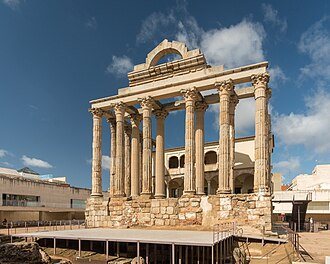
4. Temple of Diana
A Roman temple standing in the middle of the modern centre, surrounded by cafés and streets. It is a brilliant quick stop because the contrast is so obvious: ancient columns, contemporary town life, and often children running around the square while parents take photos. It is also close to food and Plaza de España, so it fits naturally into a reset break.
- Age suitability: All ages
- Time needed: 15–30 minutes
- Cost: Free from outside
- Pro tip: Best in the evening when the stone is lit and nearby terraces start filling.
5. Roman Circus
The circus is where Mérida’s chariot-racing story lives. It is less instantly beautiful than the theatre, but it is arguably more fun to explain to children: imagine teams of horses thundering around a long track while the city roared. Because the site is stretched out, it helps to use the interpretation panels and keep the visit purposeful.
- Age suitability: Best from 6+ if they like history or racing stories
- Time needed: 45–75 minutes
- Cost: Included in multi-site ticket
- Honest note: It can feel sparse without context. Tell the chariot story before you arrive.
🏰 Bridges, Forts & Open-Air Wanders
6. Alcazaba of Mérida
The Moorish fortress sits beside the Guadiana and Roman Bridge, adding a different layer to a city that can otherwise feel all-Roman. Children get walls, gates, water cisterns and fortress views, while adults get a clear sense of how Mérida kept being reused by later powers.
- Age suitability: All ages; supervise on walls and steps
- Time needed: 45–75 minutes
- Cost: Included in the archaeological ticket
- Pro tip: Combine with the Roman Bridge and riverside walk rather than treating it as a standalone outing.
7. Roman Bridge over the Guadiana ⭐
One of Mérida’s easiest family wins: a long Roman bridge across the Guadiana River, now pedestrian-friendly and good for a low-pressure walk. It gives everyone space after narrow streets and museums, and the views back toward the city help connect the ruins to the landscape.
- Age suitability: All ages
- Time needed: 30–60 minutes depending how far you walk
- Cost: Free
- Pro tip: Sunset is lovely and much kinder than midday sun.
8. Acueducto de los Milagros ⭐
The Aqueduct of Miracles is one of Mérida’s most dramatic sights for children: tall brick-and-stone arches marching across open ground, with nesting storks often visible in season. It feels wilder and more spacious than the central monuments, and it photographs beautifully.
- Age suitability: All ages
- Time needed: 30–60 minutes
- Cost: Free outside
- Pro tip: Go early or late for cooler weather and better light; bring water because there is less immediate café backup.
9. Arco de Trajano and Pórtico del Foro
These are short, useful city-walk stops rather than major attractions. The Arch of Trajan gives a quick Roman-gate moment near restaurants, while the Forum Portico helps children understand that ancient Mérida was a whole city, not just isolated monuments.
- Age suitability: All ages
- Time needed: 10–20 minutes each
- Cost: Free from outside
- Pro tip: Use them as scavenger-hunt stops between the Temple of Diana, Plaza de España and dinner.
🏺 Smaller Sites Worth Adding
10. Casa del Mitreo
A Roman house site with mosaics and domestic remains that helps shift the story from emperors and gladiators to everyday life. It is especially useful for children who like maps, houses and imagining where people slept, cooked and gathered.
- Age suitability: Best from 6+
- Time needed: 30–60 minutes
- Cost: Included in multi-site ticket
- Pro tip: Pair with the nearby Columbarios area if your family still has energy.
11. Morería Archaeological Area
A layered archaeological zone near the centre, showing Roman streets, later buildings and the way Mérida has been rebuilt over centuries. It is more of a context stop than a wow moment, so keep it short with children.
- Age suitability: Best from 8+
- Time needed: 30–45 minutes
- Cost: Included in the monument circuit
- Honest note: Skip if your kids are already ruined-out.
12. Basilica of Santa Eulalia and Crypt
A Christian heritage stop built around Mérida’s patron saint, with an archaeological crypt beneath. It gives a useful change of tone from Roman civic monuments and can work well on a slower second morning.
- Age suitability: Best from 6+
- Time needed: 30–60 minutes
- Cost: Often included in combined ticket options
- Pro tip: Use it before or after the museum/central café loop rather than as a separate expedition.
🌿 Nature & Day Trips
13. Proserpina Reservoir
A Roman-origin reservoir north of town that locals use for walks, simple meals and warm-weather downtime. It is not a polished beach resort, but it can be a sanity-saving change of scenery if children need water views and open space after ruins.
- Age suitability: All ages
- Time needed: Half day if you have a car
- Transport: Car or taxi easiest
- Honest note: Check water conditions and facilities seasonally before promising swimming.
14. Cornalvo Natural Park
Cornalvo gives families a nature break within easy reach of Mérida, with reservoir scenery, birdlife and gentle walking rather than high-drama mountain trails. It is best for families with a car who want one low-key outdoor block between heritage towns.
- Age suitability: All ages if heat is managed
- Time needed: Half day
- Transport: Car required
- Pro tip: Avoid the hottest part of summer days; shade can be limited.
15. Cáceres or Trujillo Day Trip
If you are building an Extremadura itinerary, Cáceres and Trujillo are the obvious add-ons. Cáceres has a walled medieval old town with Game-of-Thrones energy; Trujillo has a castle, main square and conquistador history. Both are better with a car and older children who enjoy atmospheric old towns.
- Age suitability: Best from 6+
- Time needed: Full day
- Pro tip: Do not cram both into one day with kids. Choose one and slow down.
🍽️ Family-Friendly Food in Mérida
Mérida is a good eating city for families because the centre is compact and Extremaduran food is hearty. Look for torta del Casar, jamón ibérico, grilled pork, croquetas, migas, gazpacho/salmorejo in warm weather, simple bocadillos and tapas that let children graze rather than commit to one unfamiliar plate.
Good family-use picks include:
- A de Arco — atmospheric choice by the Arch of Trajan; useful when parents want a proper regional meal without leaving the centre.
- La Tahona — central, polished, and good for sharing plates with older kids.
- Rex Numitor — reliable sit-down option near the central sightseeing loop.
- La Carbonería — practical central restaurant for grilled meats and classic Spanish choices.
- Casa Benito — casual stop on Calle Santa Eulalia when you need straightforward food between monument visits.
- Serendipity — handy near the museum/theatre area; good for an easier child-friendly reset.
- Shangri La — useful if everyone needs a break from Spanish food.
- 35 Burger — not a cultural essential, but extremely useful when children are done being adventurous.
- Capriccio Italiano — pizza/pasta safety valve if staying outside the tight centre.
- Mercado de Calatrava — useful snack/market stop in the centre; check current stalls and hours.
Pro tip: Build meals around the Roman rhythm: ruins early, long lunch, museum/siesta, then bridge or Temple of Diana in the evening. Mérida rewards families who do less at midday.
🗓️ Easy 2-Day Family Itinerary
Day 1 — Theatre, Museum & Central Mérida
- Start with the Roman Theatre and Amphitheatre at opening time
- Visit the National Museum of Roman Art before the day gets too hot
- Lunch near Calle José Ramón Mélida or Plaza de España
- Short afternoon rest
- Temple of Diana, Arch of Trajan and Pórtico del Foro scavenger-hunt walk
- Dinner near the centre
Day 2 — Bridge, Fortress, Circus & Aqueduct
- Alcazaba and Roman Bridge in the morning
- Walk or taxi to the Roman Circus
- Lunch and downtime
- Casa del Mitreo or Basilica of Santa Eulalia depending family energy
- Late afternoon Acueducto de los Milagros for space, storks and photos
If you only have one day: Theatre/Amphitheatre, museum, Temple of Diana, Alcazaba, Roman Bridge. Save the Circus and aqueduct for a longer visit.
🛏️ Where to Stay with Kids
Historic centre / Plaza de España: Best for first-time families. You can walk to food, the Temple of Diana, Alcazaba and most evening strolls.
Theatre/Museum side: Practical if Roman sites are the main focus. You will be close to the big-ticket monuments and can retreat to the hotel during heat.
Outside centre / parking-friendly hotels: Sensible on a road trip, especially with younger children and luggage. You trade atmosphere for easier arrivals.
⚠️ Honest Family Notes
- Mérida is history-heavy. If your children dislike ruins, keep the visit to one night.
- Summer heat can derail plans quickly; shade and timing matter more than squeezing in every monument.
- Combined tickets are good value, but do not treat them as a challenge to see everything.
- Some archaeological sites have uneven ground and limited shade.
- Restaurants may keep Spanish hours; have snacks ready if kids eat early.
🎒 Packing & Practical Tips
- Bring hats, sunscreen and refillable water bottles most of the year.
- Use a carrier rather than a heavy stroller for the archaeological sites.
- Tell one story per site — gladiators, actors, chariots, soldiers — rather than delivering a lecture.
- Buy the multi-site ticket if seeing more than two monuments.
- Book central accommodation so afternoon rests are realistic.
📋 Quick Reference: Activities at a Glance
| Activity | Best Ages | Time | Cost | Notes |
|---|---|---|---|---|
| Roman Theatre | 5+ | 45–75m | Paid | Top sight |
| Roman Amphitheatre | 5+ | Included | Paid | Gladiator story hook |
| National Museum of Roman Art | 6+ | 1–2h | Paid | Best indoor break |
| Temple of Diana | All | 15–30m | Free outside | Easy central stop |
| Roman Circus | 6+ | 45–75m | Paid | Chariot racing context |
| Alcazaba | All | 45–75m | Paid | Fortress + river views |
| Roman Bridge | All | 30–60m | Free | Best sunset walk |
| Acueducto de los Milagros | All | 30–60m | Free | Big arches, open space |
| Casa del Mitreo | 6+ | 30–60m | Paid | Roman house/mosaics |
| Basilica Santa Eulalia | 6+ | 30–60m | Paid | Crypt and saint story |
| Proserpina Reservoir | All | Half day | Free/varies | Car useful |
| Cornalvo Natural Park | All | Half day | Free | Nature reset |
✈️ Getting to Mérida
Closest airport: Badajoz (BJZ) is nearest but has limited service. Most international families will find better options through Seville (SVQ), Madrid (MAD) or Lisbon (LIS) depending route.
From Malta: Expect to connect via Madrid, Barcelona, Seville or another Spanish hub. For a family trip, Mérida makes most sense as part of a western Spain/Extremadura itinerary rather than a standalone fly-in weekend.
By train: Mérida has rail links, but journey times can be slower than expected. Check current schedules carefully before planning a tight arrival day.
By car: This is the easiest mode for families combining Mérida with Cáceres, Trujillo, Badajoz, Seville or Portugal. Roads are straightforward and parking outside the tight centre is manageable.