🇩🇪 Trier — Family Travel Guide
Country: Germany (Rhineland-Palatinate)
Airport: Luxembourg (LUX) is easiest — ~40 minutes by car; Frankfurt (FRA) works by train
Last Updated: May 2026
Overview
Trier is Germany’s oldest city, and unlike many “historic” towns, the history is not hidden behind glass. Children can walk through a Roman city gate, stand inside an amphitheatre where gladiators once fought, climb around ruined imperial baths, cross a Roman bridge, and still be eating ice cream in a colourful market square ten minutes later. It is compact, atmospheric, and much easier with kids than trying to do Roman history in a huge capital city.
The honest version: Trier is not a blockbuster theme-park destination. It works best for families who enjoy ruins, castles, rivers, market squares and slow exploring. Younger kids may not care that the stones are UNESCO-listed, but they will enjoy the tunnels, gates, steps, gardens, fountains and snack-friendly old town. Older kids get a surprisingly vivid Roman story without the crowds of Rome.
Why families love it:
- Porta Nigra is one of Europe’s most memorable Roman monuments and easy to understand visually
- The old town is compact: most major sights sit within a 15–25 minute walk
- Ruins are tactile and outdoorsy, not just museum corridors
- Plenty of parent-friendly food: schnitzel, potatoes, flammkuchen, ice cream, bakeries and Mosel wine terraces
- Excellent rainy-day backup at the Rheinisches Landesmuseum and Toy Museum
- Easy day trips to Saarburg, Mosel viewpoints and Luxembourg City
- Good value compared with bigger German city breaks
⏰ Best Time to Visit with Kids
| Season | Conditions | Verdict |
|---|---|---|
| Apr–Jun | 14–24°C, fresh vines, comfortable walking | ⭐ Best overall |
| Jul–Aug | 22–30°C, warm, festivals, busy terraces | ✅ Good if you start early |
| Sep–Oct | 15–24°C, grape harvest, mellow Mosel light | ⭐ Excellent |
| Nov–Mar | 2–10°C, shorter days, Christmas market | ✅ Cosy but plan indoor breaks |
Pro tip: Trier is brilliant in May/June or September. You get long days, Roman ruins without heat fatigue, and vineyards/river scenery at their best. In July/August, do Porta Nigra and the amphitheatre early, then retreat to museums, gardens and ice cream.
🚗 Getting Around
On foot Stay near the Altstadt and you can do most of Trier without transport. Porta Nigra, Hauptmarkt, the cathedral, Liebfrauenkirche, Karl Marx House, the Toy Museum, Palastgarten and several Roman sites are walkable. Bring a stroller for toddlers, but expect cobbles and occasional steps around ruins.
Bus Local buses are useful for Petrisberg viewpoints, Zurlauben riverside restaurants and the Mariensäule hill area. For a short family stay, walking plus the odd taxi is easier.
Car You do not need a car inside Trier. A car becomes useful for Saarburg, Mosel villages, Eltz Castle, Luxembourg or a vineyard-style countryside day. Use car parks on the edge of the old centre rather than trying to drive into pedestrian streets.
Train Trier Hauptbahnhof is a 10–15 minute walk from Porta Nigra. Regional trains connect to Luxembourg, Koblenz, Saarbrücken and Cologne, though families with luggage may prefer a transfer from Luxembourg Airport.
🏛️ Roman Trier — The Big Hits
1. Porta Nigra ⭐
Trier’s blackened Roman gate is the reason many families come. It looks like a fortress, a castle and a giant history prop all at once. Children can understand it instantly: this was the city gate, people walked through it, soldiers watched from above, and almost 2,000 years later it is still standing.
- Age suitability: All ages; best from 5+
- Cost: Exterior free; interior ticket usually modest, children discounted
- Time needed: 45–90 minutes
- Location: Simeonstraße, northern edge of the old town
- Pro tip: Start here. It gives the whole trip a story. Go inside if your kids like stairs and views; otherwise the exterior still delivers.
2. Amphitheater Trier
The amphitheatre sits just outside the old centre and feels more adventurous than it looks on a map. Kids can stand in the arena, peer into underground spaces and imagine the noise of Roman crowds. It is not polished or theme-parked, which actually helps — it feels like a real ruin.
- Age suitability: Best from 5+; younger kids still enjoy the open space
- Time needed: 45–75 minutes
- Honest note: It is a 20–25 minute walk from Porta Nigra. Take snacks and water if walking with small children.
- Pro tip: Pair it with Kaiserthermen and Palastgarten on a Roman loop rather than crossing town repeatedly.
3. Kaiserthermen (Imperial Baths) ⭐
The Imperial Baths are the most fun Roman ruins for kids who like tunnels, arches and hide-and-seek energy. The remains are huge, and the underground service passages help children understand that Roman engineering was not just pretty facades.
- Age suitability: Best from 5+
- Time needed: 45–90 minutes
- Pro tip: Do this before the museum. Walking through the ruin first makes the models and artefacts in the Landesmuseum much more meaningful.
4. Barbarathermen
These Roman bath ruins are less complete than Kaiserthermen but useful for showing the scale of Roman Trier. Treat them as a short outdoor stop rather than a main event.
- Cost: Usually free to view from the walkway
- Time needed: 15–30 minutes
- Best for: Families already walking toward the Roman Bridge
5. Römerbrücke (Roman Bridge)
The Mosel bridge has Roman foundations and is still in daily use — a nice “history is under your feet” moment. It is not a long attraction, but it connects well with riverside walks and the west side views.
- Time needed: 15–30 minutes
- Pro tip: Walk here in late afternoon, then head toward Zurlauben or back into the old town for dinner.
⛪ Old Town, Churches & Market Squares
6. Hauptmarkt ⭐
Trier’s main square is exactly what family city breaks need: colourful facades, fountains, cafés, bakeries, street life and enough open space for everyone to reset. Use it as your snack base between Roman sights.
- Age suitability: All ages
- Cost: Free unless pastries happen, and pastries should happen
- Time needed: 30–90 minutes
- Pro tip: Give kids a fountain-and-sign-hunting mission while adults get coffee.
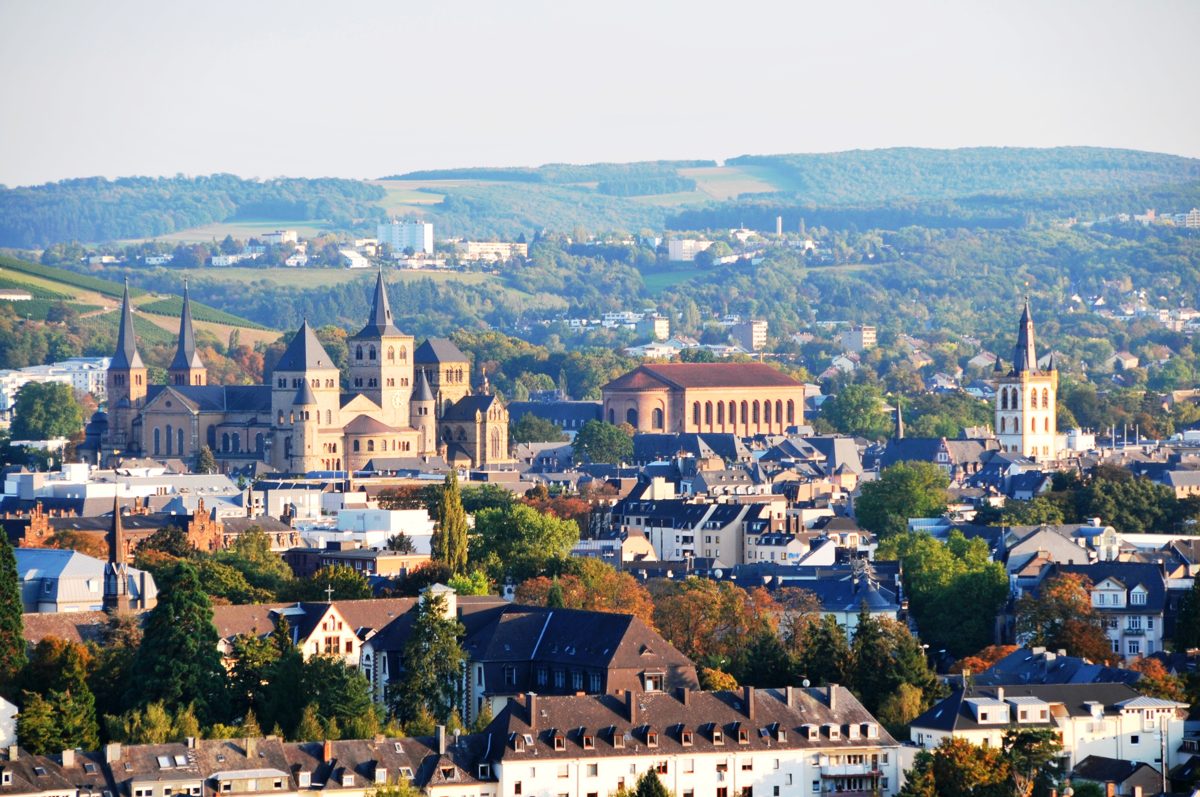
7. Trier Cathedral & Liebfrauenkirche
The cathedral complex is one of Trier’s great surprises: Roman foundations, medieval layers, a calm cloister atmosphere and the neighbouring Church of Our Lady. Keep the visit short and visual rather than turning it into a church marathon.
- Age suitability: Best from 6+; toddlers need a quick pass
- Time needed: 30–60 minutes
- Honest note: If children are already ruined-out, do the exterior and cloister-style quiet moments only.
8. Palastgarten & Electoral Palace ⭐
This is the easiest family decompression zone in the centre: formal gardens, lawns, flower beds and the pink Electoral Palace facade. It is next to the Imperial Baths, so it works beautifully as a picnic and run-around stop.
- Cost: Free gardens
- Time needed: 30–75 minutes
- Pro tip: Put this after Kaiserthermen. Ruins first, garden reset second.
9. Spielzeugmuseum Trier (Toy Museum)
A small toy museum just off the old town, useful when rain, cold or museum fatigue threatens the day. Expect dolls, trains, model toys and nostalgia rather than high-tech interactivity.
- Age suitability: Best for 4–10 and toy-loving adults
- Time needed: 45–75 minutes
- Honest note: It is charming rather than essential. Use it as a flexible backup.
🧠 Museums & Older-Kid History
10. Rheinisches Landesmuseum Trier ⭐
This is the museum that makes Roman Trier click. Mosaics, coins, statues, models and archaeological finds give context to all the ruins outside. It is best with school-age children who can connect objects to places they have already seen.
- Age suitability: Best from 7+
- Time needed: 1.5–2.5 hours
- Pro tip: Do not start here cold. Visit Porta Nigra or Kaiserthermen first, then use the museum to answer “how did they build all this?“
11. Karl Marx House
Karl Marx was born in Trier, and his birthplace is now a museum. It is more text-heavy than child-focused, so this is mainly for politically/history-curious older kids or parents who specifically want it.
- Age suitability: Best from 12+
- Time needed: 45–75 minutes
- Honest note: Skip without guilt if your children are young. Trier has better family-value sights.
12. Viehmarktthermen
Another Roman bath site, this time under a glass building near the centre. It is a useful short stop if you want one more Roman layer without walking far.
- Age suitability: Best from 6+
- Time needed: 20–45 minutes
- Pro tip: Use it as a quick add-on near lunch, not as a standalone expedition.
🌳 Views, River & Outdoor Breaks
13. Mosel riverside & Zurlauben
The Mosel river gives Trier breathing space. Zurlauben, the old riverside fishing quarter, has terraces, paths and a calmer feel than the centre. It is a good dinner direction if everyone needs air after Roman stones and cobbles.
- Best for: Evening strolls, relaxed meals, stroller walking
- Time needed: 45 minutes to a full evening
14. Petrisberg
The Petrisberg plateau gives city views, green space and playground energy away from the old centre. It is not essential for a one-day Trier visit, but useful if you have active children and time to spare.
- Age suitability: All ages
- Time needed: 1–2 hours
- Pro tip: Go by bus/taxi rather than making tired kids climb for it.
15. Mariensäule viewpoint
The column on the west side of the Mosel gives one of the classic views back across Trier. Best for families with a car or older kids who enjoy viewpoint missions.
- Time needed: 30–60 minutes
- Honest note: Not worth forcing with toddlers unless you are already nearby.
🍽️ Food Experiences Families Actually Use
Trier’s food scene is extremely practical with kids: German portions, Italian backup, potato dishes, bakeries, ice cream and casual wine taverns where families are normal at early dinner. The trick is not to chase formal fine dining. Eat near the old town for convenience, then do one Mosel-style meal if you have time.
Easy family wins:
- Kartoffel Restaurant Kiste — potato-focused, central, simple comfort food that works well with hungry children.
- Zum Domstein / old-town taverns — Roman-theme/local dishes near the Hauptmarkt; good for a classic Trier meal.
- Weinstube Kesselstatt — lovely setting beside the cathedral; better with slightly older kids or lunch outdoors.
- Bitburger Wirtshaus — central, predictable German food, parent-friendly beer, easy for families.
- Donna Mia — pizza/pasta safety net on Kornmarkt.
- Brasserie zur Sim — convenient near Porta Nigra when you need food without logistics.
- Calchera Eiscafé — the strategic ice cream stop after Porta Nigra.
- Zurlauben riverside terraces — best for a low-pressure evening meal by the Mosel.
Pro tip: Trier is a bakery breakfast city. Buy rolls, pastries and fruit, then save sit-down patience for lunch or dinner. If your kids are suspicious of regional German food, rotate between schnitzel/potatoes, Italian, burgers and ice cream.
🌊 Day Trips
16. Saarburg ⭐
Saarburg is the easiest fairytale add-on: a small town with a waterfall running through the centre, castle ruins above, cafés and river scenery. It gives families a different texture from Trier without a huge travel day.
- Travel time: ~25–35 minutes by car or train
- Best for: Half-day trip, castle/waterfall photos, easy wandering
17. Luxembourg City
Luxembourg City is surprisingly close and makes sense if you fly via LUX. The casemates, old fortifications, lifts, ravines and international feel are excellent with older kids.
- Travel time: ~45 minutes by car; trains/buses also possible
- Honest note: It can feel like a separate city break. Do it only if you have 3+ days or are using Luxembourg Airport.
18. Mosel villages & viewpoints
The Mosel valley is the reason to slow down: vineyards, river bends, small towns and castles. Families with a car can do a gentle loop; without one, keep it simple and use train-friendly stops.
- Best for: Scenery, parent wine interest, relaxed picnic day
- Pro tip: Do not over-plan vineyards with young children. Pick one village, one viewpoint, one meal.
💡 Practical Tips for Families
- Start at Porta Nigra. It is the clearest hook and helps children understand the Roman theme.
- Do ruins in a loop. Porta Nigra → Hauptmarkt/cathedral → Kaiserthermen → Palastgarten → amphitheatre works better than zigzagging.
- Bring layers and rain backup. Trier weather changes quickly; the Landesmuseum and Toy Museum rescue wet afternoons.
- Keep churches short. The cathedral is impressive, but children burn out if every beautiful old building becomes a lecture.
- Use bakeries aggressively. German bakeries solve breakfast, snacks and morale.
- Book central accommodation. Staying near the old town removes transport stress and makes midday breaks easy.
- Luxembourg Airport is often the smartest gateway. Especially from Malta/Europe, LUX can be easier than routing through German hubs.
📋 Quick Reference: Activities at a Glance
| Activity | Best Age | Time | Cost | Family Verdict |
|---|---|---|---|---|
| Porta Nigra | 5+ | 45–90m | Low | ⭐ Must-do |
| Amphitheater | 5+ | 45–75m | Low | ⭐ Great active ruin |
| Kaiserthermen | 5+ | 45–90m | Low | ⭐ Best ruins for tunnels |
| Hauptmarkt | All ages | 30–90m | Free | Easy snack base |
| Cathedral & Liebfrauenkirche | 6+ | 30–60m | Free/low | Beautiful, keep short |
| Palastgarten | All ages | 30–75m | Free | Best run-around reset |
| Rheinisches Landesmuseum | 7+ | 1.5–2.5h | Moderate | Best context museum |
| Toy Museum | 4–10 | 45–75m | Low | Rainy-day backup |
| Karl Marx House | 12+ | 45–75m | Moderate | Older-kid niche |
| Römerbrücke | All ages | 15–30m | Free | Quick river/history stop |
| Zurlauben riverside | All ages | 45m+ | Meal cost | Relaxed evening |
| Petrisberg | All ages | 1–2h | Free | Green-space backup |
| Saarburg | 5+ | Half day | Transport | ⭐ Best day trip |
| Luxembourg City | 8+ | Full day | Transport | Strong if using LUX |
✈️ Getting to Trier
From Malta: There are usually no direct Malta–Trier flights because Trier has no commercial airport. The most family-friendly route is flying to Luxembourg (LUX), then taking a rental car, transfer or public transport to Trier in around 40–60 minutes. Frankfurt (FRA) is another option, but the onward train/drive is longer.
Best airport: Luxembourg (LUX) for convenience; Frankfurt (FRA) for more flight choice; Hahn (HHN) only if the specific low-cost routing works and you have a car.
By train: Trier Hauptbahnhof is close to the old centre. Trains connect with Luxembourg, Koblenz, Cologne and Saarbrücken.
Ideal stay: 2 nights / 3 days gives you one Roman old-town day, one museum/river day and one Saarburg or Mosel/Luxembourg add-on. If you only have one day, do Porta Nigra, Hauptmarkt, cathedral, Kaiserthermen and Palastgarten.