🇮🇹 Trieste — Family Travel Guide
Country: Italy (Friuli Venezia Giulia region) Airport: Trieste–Friuli Venezia Giulia Airport (TRS) Last Updated: March 2026
Overview
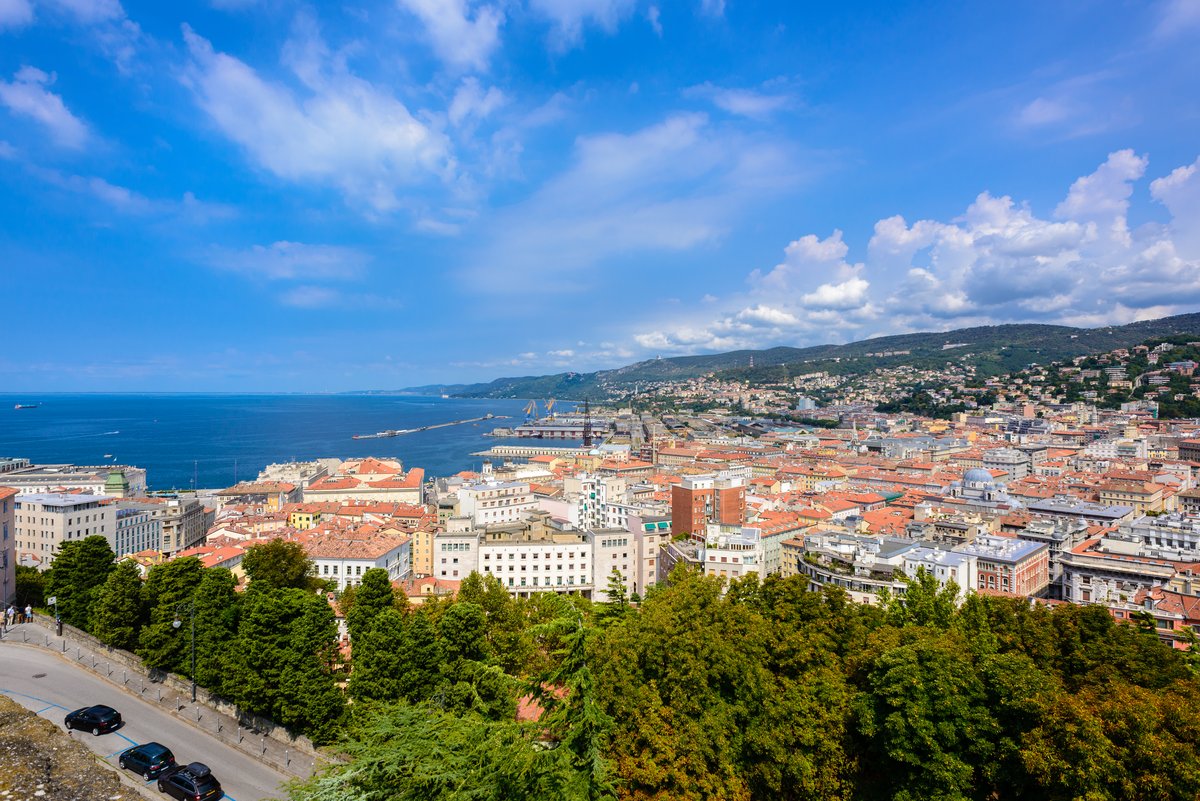
Trieste is one of Europe’s great misunderstood cities — a Habsburg port stranded in the northeast corner of Italy, pressed between Slovenia, the Adriatic Sea, and a dramatic limestone plateau called the Karst. It is cosmopolitan in a way no other Italian city can claim: part Viennese, part Slavic, part Mediterranean, shaped by centuries as the main seaport of the Austro-Hungarian Empire. The result is a city of grand art nouveau cafés, waterfront piazzas, two medieval castles, a unique dinosaur, Europe’s largest show cave nearby, and a coffee culture that puts Milan to shame.
For families it’s an unexpected gem: manageable in size (230,000 people), genuinely safe, walkable, and packed with child-friendly experiences. Kids walk across a genuine drawbridge into a 15th-century fortress, descend 100 metres underground into the world’s largest tourist cave, and discover that the most complete dinosaur ever found in Europe was dug up just down the road. There’s also a rocky coastline beloved by locals for summer swimming, and Slovenia is just 30 minutes away.
Why families love it:
- Compact and extremely safe — walkable historic centre
- Two castles, a cave, and a dinosaur: built-in narrative hook for kids
- Italy’s coffee capital — for parents, this matters deeply
- Gateway to Slovenia: Postojna Cave, Piran and Ljubljana all under 2 hours
- Not yet overrun by mass tourism — real local prices
- Strong multicultural identity: Italian, Austro-Hungarian, Slavic all visible at once
⏰ Best Time to Visit with Kids
| Season | Conditions | Verdict |
|---|---|---|
| Apr–Jun | 15–25°C, sunny, little rain | ⭐ Best for families |
| Jul–Aug | 28–34°C, hot and busy | ✅ Good but coastal areas pack out |
| Sep–Oct | 18–26°C, sea still warm, calm | ⭐ Excellent |
| Nov–Mar | 5–12°C, bora wind possible | 🟡 Good for city/caves, skip beach |
The Bora: Trieste’s famous katabatic wind can hit 100 km/h+ in winter with almost no warning, dropping temperatures sharply and making outdoor walks miserable. In summer and autumn it’s usually mild or absent. If you visit Oct–Mar and the bora is blowing, pivot to indoor activities — the cave, museums, and historic cafés are all perfect bora retreats.
🚗 Getting Around
By Car (Recommended for Day Trips) Trieste’s city centre is compact enough to walk, but a car is essential for reaching Grotta Gigante (20 min), Val Rosandra (20 min), the Slovenian coast (45 min) and Postojna Cave (1 hr). Rent at TRS airport or in the city. Parking in the centre can be tight; use the multi-storey at Piazza della Libertà.
On Foot The historic centre (Piazza Unità d’Italia → Canale Grande → San Giusto Hill) is thoroughly walkable. Flat from the seafront, steep going up to the castle. Bring the carrier for toddlers on the hill.
Public Bus (Trieste Trasporti) Reliable and cheap. Bus 6 goes to Miramare Castle along the coast (20 min). Tickets ~€1.45 single. Day passes available. The hop-on hop-off tourist bus covers main sights and is a fun option with kids for orientation.
Taxi / Ride Share Taxis are metered and fairly affordable. From centre to Miramare ~€12; to Grotta Gigante ~€25.
🏰 Heritage & History (Unique to Trieste)
1. Castello di Miramare — The Habsburg Sea Castle
This is Trieste’s signature sight and one of the most romantically located castles in Europe. Built from 1856–1860 by Archduke Maximilian of Habsburg (later the ill-fated Emperor of Mexico), it sits on a rocky promontory thrusting into the Adriatic, surrounded by a 22-hectare English park full of deer, peacocks, and jaw-dropping sea views. The interior is preserved exactly as the Habsburg family left it — gilded staterooms, a nautical-themed bedroom, and Maximilian’s tragic story (he was executed in Mexico in 1867) give it an air of dark fairy tale that older kids find riveting.
- TripAdvisor Rating: 4.5/5 (6,000+ reviews) — consistently one of Italy’s highest-rated castles
- Age suitability: All ages; the park suits toddlers, the interior captivates 8+
- Cost: Castle museum ~€12 adult / €2 reduced (under-18s EU free); park FREE
- Time needed: 2–3 hours (castle + park)
- Hours: Daily 9am–7pm (6pm in winter)
- Getting there: Bus 6 from Piazza Goldoni (20 min), or drive (free parking nearby)
- ⚠️ Honest note: The castle interior is fairly formal — young children may find the rooms less engaging than the park. The park is the real star for families with under-8s. Book tickets online (miramare.cultura.gov.it) to skip queues in summer.
- Pro tip: The White Lady ghost story — a spectre said to haunt the cliffs — is perfect to tell kids on the walk around the headland. The castle café has a sunny terrace for lunch with sea views.
2. Castello di San Giusto — Medieval Fortress & Panorama
San Giusto Hill has been fortified since Roman times. The current 15th-century castle was built by Venice and later expanded by the Habsburgs — it’s squat, powerful, and surprisingly well-preserved, with ramparts that kids can walk along and a moat crossed by a genuine drawbridge. The views from the walls over the entire city, the Gulf of Trieste and the Karst plateau above are extraordinary. Adjacent is the Romanesque Cathedral of San Giusto with beautiful 13th-century mosaics.
- TripAdvisor Rating: 4.0/5 (1,800+ reviews)
- Age suitability: All ages; the open ramparts are a highlight for kids (supervision needed)
- Cost: Castle museum €6 adult / €4 reduced; castle-only (ramparts) ~€1; Cathedral FREE
- Time needed: 1–2 hours
- Hours: Tue–Sun 10am–5pm (museum); ramparts open dawn to dusk
- Getting there: 15-min walk uphill from Piazza Unità or short taxi
- ⚠️ Honest note: The castle interior/museum is modest — it’s mainly the views and the historical atmosphere that justify the visit. Skip the museum fee if kids are young; the ramparts and cathedral are the real draw.
- Pro tip: Combine with the Cathedral’s UNESCO-calibre Byzantine mosaics (free) — kids who can handle “ancient mosaic graffiti” themes will be fascinated. On summer evenings there are outdoor cinema and concert events in the castle courtyard.
3. Piazza Unità d’Italia — Europe’s Largest Sea-Facing Square
This isn’t just a pretty photo stop — it’s genuinely one of Europe’s most dramatic main squares, open on one side directly to the Adriatic Sea. Ringed by Habsburg-era palaces (Town Hall, Palazzo del Lloyd Triestino, Palazzo del Governo) and lit up at night, it’s the heartbeat of the city. Kids love the fountain, the space to run, and the gelato parade.
- Cost: FREE
- Time needed: 30 minutes to an hour
- Pro tip: Come at golden hour (30 min before sunset) for the light on the facades. Then walk the Molo Audace pier — a 250m stone jetty projecting into the sea — for the best city panorama. It’s free and magical at dusk.
🦕 Science & Nature
4. Grotta Gigante — Europe’s Largest Tourist Cave
This is the attraction that most surprises families visiting Trieste. Grotta Gigante (Giant Cave) holds a Guinness World Record: its single main hall is 107 metres tall, 167 metres long, and 76 metres wide — large enough to contain the Eiffel Tower with space to spare. You descend by lit staircase (500 steps down, 500 up) through a wonderland of stalactites, stalagmites, and extraordinary rock formations. The centrepiece is the “Roger Column,” a 12-metre-tall stalagmite that took millions of years to form. Tours are guided and leave every hour; the audio is good and guides adjust commentary for children.
The cave maintains a constant 11°C year-round — bring a light jacket even in August. The Karst region above is also scientifically famous: two pendulums inside the cave (the longest suspended pendulums in the world) actually measure microscopic movements in the Earth’s crust in real time.
- TripAdvisor Rating: 4.5/5 (1,500+ reviews)
- Age suitability: Best for 5+; under-4 on parent shoulders for the stairs (not practical for pushchairs)
- Cost: ~€12 adult / €8 children 6–14 / under 6 FREE; 1 free child per paying adult (check current offer at grottagigante.it)
- Time needed: 1.5 hours including getting there and back
- Hours: Tours at 10am, 11am, noon, 2pm, 3pm, 4pm (check seasonally; grottagigante.it)
- Getting there: 20 min drive; Bus 42 from Trieste also reaches it
- ⚠️ Honest note: 500 steps is real — older or mobility-impaired visitors should know in advance. Young children may find the constant darkness and echoing sounds unnerving; pack a small torch. No photos of the pendulums allowed.
- Pro tip: Book by phone (grottagigante.it) during peak summer to secure your preferred tour slot.
5. Civico Museo di Storia Naturale — Antonio the Dinosaur
Here’s a fact that floors children: the most complete dinosaur ever found in Italy — and one of the most significant in all of Europe — was discovered just 20 km from Trieste’s city centre, on a cliff above the sea at Duino. Named Antonio (species: Tethyshadros insularis), this 80-million-year-old herbivore is now the star exhibit of Trieste’s Natural History Museum, displayed alongside Bruno, another specimen from the same site. The museum also houses Carlotta, a preserved great white shark specimen, plus 2 million other artifacts from the Karst and Adriatic — fossils, minerals, insects, marine life. There’s also a 6,400-year-old human jaw showing dental work in beeswax — the world’s oldest example of dentistry.
- TripAdvisor Rating: 4.0/5
- Age suitability: Best for 5+; dinosaur exhibit captivates 6–14
- Cost: ~€6 adult / €3 reduced (combined tickets with other civic museums available; check museostorianaturaletrieste.it)
- Time needed: 1.5–2 hours
- Hours: Tue–Sun 10am–6pm
- Getting there: Via Tominz 4 — 15 min walk from Piazza Unità
- ⚠️ Honest note: The museum is on the smaller side; the dinosaur hall is the clear highlight. Manage expectations for very young children who may not yet appreciate fossil context.
- Pro tip: You can visit the actual Sito Paleontologico (the clifftop dig site at Duino where Antonio was found) on Sundays in summer — a unique add-on for dino-obsessed kids.
6. Immaginario Scientifico — Interactive Science Centre
Trieste is Italy’s science capital — home to CERN researchers, ICTP, and Area Science Park — and its science museum reflects that intellectual heritage. Housed in a historic warehouse in the Old Port (Porto Vecchio), the Immaginario Scientifico is a hands-on interactive museum where children and teenagers experiment with pendulums, soap bubble physics, whirlpools, optical illusions, and applied technology. Five thematic sections including “Fenomena” (basic science experiments), “Innova” (applied technology) and “Trieste and Science” (local research made accessible). Monthly hands-on workshops for kids on the last Sunday of each month.
- Rating: 4.0/5 on TripAdvisor
- Age suitability: Best for 5–15; some exhibits work for 3+
- Cost: ~€7 adult and child (workshops included on workshop Sundays); check immaginarioscientifico.it for current prices
- Time needed: 1.5–2.5 hours
- Hours: Check current hours on immaginarioscientifico.it (often closed Monday; different seasonal hours)
- Getting there: Magazzino 26, Porto Vecchio — 15 min walk from centre or Bus 9
- ⚠️ Honest note: Smaller than major science museums in Rome or Milan, but perfectly sized for an afternoon. Descriptions are primarily in Italian; some English, but the hands-on nature means language is less of a barrier.
🏖️ Beaches & Outdoor
7. Barcola — Trieste’s Beloved Seaside Promenade
Trieste’s beach scene is not what Italians elsewhere would call a beach — and that’s precisely what locals love about it. Barcola is a 2.5 km coastal promenade north of the city centre where Triestini have been swimming for generations. There is no sand: instead, people lay towels on the wide stone seawall, then leap or lower themselves into the Adriatic via iron ladders. The water is crystal-clear, deep, and calm. Behind the promenade is a thin pine forest that provides shade for picnics. A 1937 art deco lido (Stabilimento Balneare) offers a sea-water swimming pool, solarium, trampolines, and a kiddie pool if you want structure. The whole experience feels gloriously Italian and completely authentic.
- TripAdvisor Rating: 4.0/5
- Age suitability: Swimming fine for 5+; younger kids need close supervision (no shallow entry — it’s a seawall, not a beach)
- Cost: Promenade FREE; Lido entry ~€5–8 per person
- Time needed: Half day
- Getting there: Bus 6 or 36 from centre (~15 min)
- ⚠️ Honest note: This is NOT a sandy beach with paddling shallows — the Adriatic entry is directly off a seawall into deep water. For toddlers and non-swimmers, the lido pool is much more suitable than the open promenade. Lifeguards are limited.
- Pro tip: Come before 10am on weekdays for a peaceful experience. Pack a picnic — the pine forest has great spots and it’s far cheaper than cafés along the front. Bring water shoes for comfort on the stone entry ladders.
8. Val Rosandra Nature Reserve — Family Hiking & Roman Ruins
Just 20 minutes southeast of central Trieste lies one of its best-kept secrets: Val Rosandra, a dramatic limestone gorge with a rushing stream, ancient Roman aqueduct ruins, a waterfall, cliff faces (popular with rock climbers), and easy walking trails through oak and chestnut forest. The main valley floor trail is flat, shaded, and manageable for young children (2+ km each way); further trails climb to Karst plateau views. The Roman aqueduct fragments dotting the valley floor are genuinely atmospheric.
- Rating: 4.5/5 on various hiking platforms; consistently praised by family travel bloggers
- Age suitability: Trail walk from 3+ (flat valley floor); longer hikes from 7+
- Cost: FREE
- Time needed: 2–4 hours depending on how far you hike
- Getting there: 20 min drive to Bagnoli della Rosandra; or Bus 40 from Trieste
- ⚠️ Honest note: The upper trails get steep and are not for nervous young children. Stick to the valley floor for families with under-8s. No facilities deep in the valley — pack all food and water.
- Pro tip: The waterfall (Slap Glinščice) is a lovely turnaround point and a great place for kids to splash in summer. The route crosses into Slovenia briefly — check current rules (usually no issue for EU passport holders but worth noting).
☕ Food & Drink — Trieste’s Unique Culture
Trieste has the most distinctive food and café culture in Italy — shaped by its Habsburg past and Slavic neighbours. Understanding the differences makes the experience far richer.
The Coffee Language (Kids Will Love This)
In Trieste, you do NOT order a “caffè” as you would elsewhere in Italy. Triestini have their own coffee vocabulary:
- Nero — standard espresso (what the rest of Italy calls “caffè”)
- Capo — espresso with a drop of milk (most popular local order)
- Capo in B (capo in bicchiere) — espresso with milk in a glass, not a cup
- Deca — decaf Ordering the “wrong” coffee in Trieste is a rite of passage — locals find it charming rather than irritating.
Historic Cafés (Must-Do for Parents)
- Caffè degli Specchi (Piazza Unità) — “Café of Mirrors,” the most iconic; great for people-watching from the sea-facing piazza
- Caffè Tommaseo (Piazza Tommaseo) — one of the oldest in town, unchanged since the 1830s; James Joyce drank here
- Caffè San Marco (Via Cesare Battisti) — stunning Viennese-style interior; literary heritage; still a working café
Unique Trieste Foods to Try with Kids
- Buffet da Pepi (Via della Cassa di Risparmio 3) — Trieste’s most famous “buffet” (not what you think: a traditional working-class lunchroom serving boiled meats, pork, and sauerkraut with local mustard). Cheap, filling, loud, and completely unique to Trieste. Line up for a table.
- Jota — the local hearty soup: beans, sauerkraut, and potatoes. Warming and filling; kids who like thick soup tend to love it.
- Presnitz — a spiral pastry of Germanic heritage, stuffed with dried fruit and nuts. Every bar sells it.
- Osmize — seasonal farm-to-table pop-ups in the Karst hills above Trieste, where local farmers open their homes to sell wine, prosciutto, cheese and bread directly to visitors (marked by a frond of ivy above the door). Dates and locations at osmize.com. A wonderful half-day excursion; children love the farm atmosphere.
🗓️ Suggested Itineraries
2-Day Family Itinerary
Day 1 — The City & the Castle
- Morning: Walk Piazza Unità d’Italia and Molo Audace pier (30 min)
- Mid-morning: Canale Grande stroll → historic café break (Caffè degli Specchi or San Marco)
- Late morning: Climb San Giusto Hill — castle ramparts + Cathedral mosaics
- Lunch: Grab focaccia from a local bakery and eat in the castle garden
- Afternoon: Civico Museo di Storia Naturale (Antonio the dinosaur)
- Evening: Aperitivo at Piazza Unità; dinner at a buffet (da Pepi or da Rudy)
Day 2 — Underground & Coastal
- Morning: Drive to Grotta Gigante (arrive 15 min early for 10am tour)
- Midday: Return to city; lunch at Barcola promenade (picnic in pine forest)
- Afternoon: Barcola swimming — seawall + lido pool for younger kids
- Evening: Gelato at Gelateria Zampolli; sunset walk along Riva
3-Day Itinerary — Add Day 3
Day 3 — Miramare + Science
- Morning: Castello di Miramare — castle interior + park walk (half day)
- Afternoon: Immaginario Scientifico (Porto Vecchio)
- Evening: Old Port area dinner; free evening to explore
🗺️ Day Trips from Trieste (All Under 3 Hours)
Day Trip 1: Postojna Cave & Predjama Castle (Slovenia) ⭐ Top Recommendation
Drive time: ~1 hour from Trieste
The combination of Postojna Cave + Predjama Castle is one of Europe’s greatest family day trips, and Trieste is the perfect base. Postojna is the world’s most visited show cave — an extraordinary 24 km network of passages explored via electric mini-train (the only underground train ride in the world for tourists), then on foot through halls of stalactites and stalagmites. The cave is a constant 8°C — bring layers.
After the cave, drive 9 km to Predjama Castle — a 12th-century fortress built inside a 123-metre cliff face, half-castle, half-cave. It genuinely looks impossible. The cave system behind the castle (accessible in summer) adds another layer of underground exploration.
- Postojna Cave: Adult ~€29.90 / Child (4–12) ~€17.90 / Under 4 free. Book online at postojnska-jama.eu
- Predjama Castle: Adult ~€16 / Child ~€9.60. Combo tickets available.
- ⚠️ Honest note: Postojna can be very crowded in summer; book the first morning tour online. The cave is cold — warm layers essential even in July. The mini-train portion thrills kids universally.
- Pro tip: Leave Trieste by 8:30am to hit the 10am Postojna tour, then Predjama for lunch, returning to Trieste by 5pm comfortably.
Day Trip 2: Piran — Venice of Slovenia
Drive time: ~45 minutes from Trieste
Piran is a perfectly preserved medieval Venetian-era port town on the Slovenian coast, dramatically squeezed onto a narrow peninsula. The church of St George offers the region’s best bell tower views; the main square (Tartinijev trg) is one of the most photogenic in the region; and the old town walls date to the 13th century. It feels like a smaller, quieter, affordable version of Dubrovnik.
Kids enjoy the compact town (easily walked in 90 min), the boats in the harbour, and the swimming from the Punta headland on warm days. Good seafood restaurants are cheaper here than Trieste or Venice.
- Parking: Park at Portorož marina’s free lots; take the 10-minute coastal path to Piran (free minibus Apr–Oct)
- Cost: Town itself free; St George bell tower ~€2; parking at Portorož free
- ⚠️ Honest note: Piran is popular and the old town can feel crowded in July–August. Visit early morning or late afternoon for better photos and fewer people. Note: This is Slovenia — carry a card, as local prices are in euros but some services use Slovenian parking systems.
- Pro tip: Combine with a stop at Strunjan Nature Reserve (between Trieste and Piran) for a coastal walk and swimming from clean rocky coves.
Day Trip 3: Ljubljana — Slovenia’s Capital
Drive time: ~1.5 hours from Trieste
Ljubljana is small enough to feel manageable (285,000 people), car-free in the historic centre, and genuinely charming. The triple bridge (Tromostovje), Ljubljana Castle (reached by funicular), and the weekend open market along the Ljubljanica River are all family-friendly highlights. The castle has a great view and a puppet theatre. The whole city is walkable from the old town.
- Ljubljana Castle: Funicular adult €4 / child €2; castle free or museum tickets available
- Drive time: 1.5 hours via Kozina; no toll if routing carefully (Slovenian Vinjeta motorway sticker required — buy at border petrol station, ~€15 for 7 days)
- ⚠️ Honest note: 1.5 hours each way is a long day trip with young children. Consider staying one night in Ljubljana to do it justice.
🏨 Where to Stay
For Families
Savoia Excelsior Palace (Luxury) Grand Habsburg-era hotel directly on the seafront. Sea views, large rooms, central location. Family rooms available.
- Rates: ~€150–250/night (varies by season)
NH Collection Trieste (Mid-Range) Modern hotel near Piazza Unità. Comfortable family rooms, reliable service, good breakfast.
- Rates: ~€100–180/night
Apartment Rentals (Best Value for Families) Self-catering apartments in the city centre (Airbnb / Booking.com) give families kitchen access, more space, and authenticity. Budget ~€80–130/night for a 2-bedroom near the centre.
Near Miramare (Best for Beach-Focused Families) Several apartment complexes and smaller hotels along the coastal road between Trieste and Miramare, within walking distance of the castle and the sea. Bus 6 connects to centre in 20 minutes.
💡 Essential Tips for Families
Stroller Practicality The flat seafront and city centre are pushchair-friendly. The climb to San Giusto Hill is steep — a carrier is better for babies/toddlers. Miramare Park has smooth paths suitable for pushchairs.
Language Italian is the primary language; in border areas some Slovenian. English is spoken at all major tourist attractions. Basic Italian greetings go a long way.
Currency Euro (€). Slovenia is also Euro.
Driving to Slovenia No border checks (Schengen area) but: Slovenia requires a vinjeta (motorway sticker) for driving on their highways — buy at border petrol stations (~€15 for a week). Not needed for driving to Piran via regional roads.
Jellyfish Season From April–June, jellyfish (mauve stingers) can appear in the Canale Grande and coastal areas. They sting. Check local conditions before open-water swimming.
Packing for the Cave Grotta Gigante is 11°C year-round. Even in August, bring a light fleece or warm layer for children.
FVG Card The Friuli Venezia Giulia tourist card (FVGCard — fvgcard.it) offers free or discounted entry to many attractions including Grotta Gigante, city museums, and public transport. Worth checking before arrival.
📊 Quick Budget Guide
| Category | Budget | Notes |
|---|---|---|
| Family apartment (3 nights) | €240–390 | Self-catering |
| Grotta Gigante (family of 4) | ~€40 | With 1 free child offer |
| Miramare Castle | ~€28 | Adults only; under-18 EU free |
| San Giusto Castle | ~€16 | Ramparts only is ~€4 |
| Natural History Museum | ~€18 | |
| Immaginario Scientifico | ~€28 | |
| Postojna + Predjama day trip | ~€120 | Family of 4 |
| Daily food (picnic + one restaurant) | ~€40–60 | Self-catering reduces this |
| Total 3-night family trip (4 people) | ~€600–900 | Including accommodation |
⚠️ Honest Downsides
- Not a beach holiday base: Trieste’s coastline is rocky seawall, not sandy beach. If beach holidays are the priority, look elsewhere. For swimming it’s fine; for bucket-and-spade play, it’s not.
- Bora wind: Can ruin outdoor plans with no notice, especially Oct–March. Always have an indoor backup plan.
- Limited nightlife / entertainment for teens: Trieste is not a party city. For teenagers wanting buzz, it may feel quiet after 2–3 days.
- Tourist infrastructure is thinner than Rome or Florence: Fewer English-language tours, some museums have Italian-only signage. This is part of the charm but worth knowing.
- Jellyfish: In spring and early summer, coastal swimming can be disrupted.
- San Giusto Hill: The climb is real. Not recommended with a pushchair; carrier required for young children.